
Burnout this deep doesn’t feel like stress; it feels like drowning. Sustainable wellness starts when you learn to reach back toward yourself.
If your burnout feels like it’s seeping into your bones—if rest feels inaccessible, recovery feels impossible, and you’re no longer sure who you are outside of being helpful—this post is for you.
Many high-achieving helpers reach this point. You’re not “just tired.” You’ve passed tired and pushed through depleted. Now you’re crispy on the outside, hollow on the inside, and just trying to keep moving because slowing down feels scarier than the mental breakdown you know that you need. This is what I call soul-deep burnout. It’s not just about needing a nap or taking a vacation. It’s about needing a complete re-orientation of how you care for yourself, how you protect your time, and how you stay rooted to what actually matters to you outside of your identity as a helper.
If you’re a therapist, caregiver, or helping professional in Texas and you’re looking for therapy that honors just how deep this burnout, anxiety, and people-pleasing goes, welcome. I see you. Let’s talk about how to rebuild your wellness in a way that’s sustainable. Be gentle with yourself. And just bold enough to ask: ‘What would feel better than this?
Step One: Start With What You Value (Not What You “Should” Do)
When we’re burned out, we often try to fix it by doing more of the things we think we’re “supposed to” do—meal prep, extensive morning routines, ten-step skincare before bed. But if your self-care routine is rooted in shame or comparison, it’s not going to help. It’s just going to become another thing you’re failing at. Please stop “should-ing” all over yourself.
Instead, anchor your wellness to your values.
Try This: A Simple Values Card Sort
Use a values card sort to help you identify your top 3 values. This can be done with printable cards, online, or even a simple list on your phone. Go through the values and ask yourself:
Which of these feels non-negotiable for the life I want?
Which of these makes me feel most like myself?
Which ones feel alive for me—even when I’m struggling?
Once you’ve narrowed it down, write those three values on a sticky note. That’s your compass. Your wellness routine should protect, reflect, and support these.
Step Two: Build in “Admin Recovery” and “Emotional Detox” Time
Most of my clients are running from session to session without time to pee or eat a sneak, then from work to laundry, all while managing inboxes and emergency calls on-the-go outside of working hours, without stopping to exhale.
Protected time off doesn’t just mean vacation. It means creating labeled blocks in your calendar where you are deliberately unavailable, not just for face-to-face appointments, but for emotional output in general. For the young adult folks I serve, most feel obligated to work longer hours because they don’t have kids or other commitments that offer a hard stop time. But, let me offer this reframe: you are your own family. Please take care of yourself.
Call It What It Is
Try naming these calendar blocks things like:
Admin Recovery Block
Emotional Detox Hour
You are Your Own Family
Not Available / OOO (Out of Oxygen)
It might feel silly, but labeling your time this way helps validate that your emotional labor has a cost, and that you’re allowed to budget for recovery. What doesn’t get scheduled, doesn’t happen. It’s a visual reminder that you have committed to re-prioritizing yourself and building a more sustainable wellness practice. I have been practicing these calendar blocks for about a year, and it makes me stop before I overbook myself!
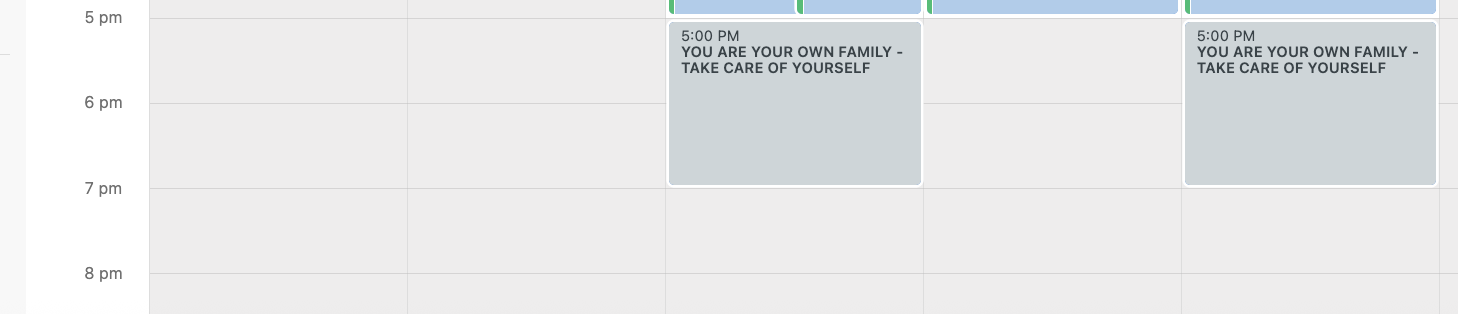
A calendar block reminder that reads, “You are your own family. Prioritize yoursel.”. A gentle nudge toward sustainable self-care for burned-out therapists seeking online therapy in Texas
Additional tip: However long you think something will take, double the time allotted and slow yourself down. Your nervous system will thank you.
Use these blocks to drink water, do something you love, walk your dog, or just lie down with your eyes closed. No productivity. No guilt. Just you, existing.
Step Three: Focus on Low-Effort, High-Impact Wellness
Burnout isn’t cured by a one-time 90-minute yoga class and an overpriced Buddha bowl (if you see me eating kale, please check on me). When you’re soul-deep in it, wellness has to be effortless and accessible.
Here are some real-life, low-effort ideas I recommend to my helpers, healers, & therapists experiencing burnout:
Snacks in a Bowl by Your Desk
You don’t need to cook a hot lunch to stay nourished. Keep snacks visible and reachable:
A bowl of nuts and dried fruit
A banana and a protein bar
Chocolate square, chips, squeezable fruit pouch
“Deconstructed sandwich” - who says that you have to make the sandwich? Eat a slice of ham. Later, eat some cheese. Your stomach doesn’t know the difference.
Electrolyte packet next to your water bottle
We aren’t looking for that “ideal” plate or for our meal to look like some influencer. Being fouled and nourished is the goal. Your brain cannot create new neural pathways without adequate fuel, so please sip, snack, and breathe.
Frictionless Movement
You don’t have to “work out.” You just have to move.
Walk during a phone call or webinar/training
Do five sitting cat-cow stretches between clients
Keep a foam roller under your desk
Wellness doesn’t need to be aspirational. It needs to be available. Exercise is stress on the body, and I am going to guess that you don’t need any more stress in your life. You may not be ready to add in exercise or movement, and that’s okay too.
Step Four: Lean on Your Community Through Check-In Pods
Remember those work colleagues that you wish had their door open more often? Let’s reach out to them to start a group chat. We could all use a little extra social support. And, not all support has to be formal supervision. Sometimes you just need someone to say, “That sucks. Me too.”
What is a Check-In Pod?
A check-in pod is a private group of 2–3 therapist friends or colleagues who agree to check in periodically (weekly or biweekly) with a single prompt. For example:
Here’s what’s hard this week…
Send an emoji reflecting your mood
Describe how you’re feeling today in three words
You don’t need to process it. You don’t need to fix it. You don’t even need to reply if you don’t have the energy. The pod is simply a place to drop what you’re holding, so you’re not holding it alone. This kind of micro-support system helps reduce isolation and builds community resilience, without requiring more emotional labor. Do not disclose any client information or violate HIPAA. This isn’t a case consultation. Focus on YOUR experience. YOUR emotions.
Step Five: Understand the Difference Between Community Care and Aftercare
One of the reasons so many therapists and helping professionals feel broken by burnout is that we’ve been told it’s our fault and instructed to fix it alone. We are told to meditate more, sleep better, and journal deeper instead of critically examining the systems that burned us out in the first place. But managing burnout isn’t a solo project.
Let’s break down two essential parts of sustainable wellness that often get overlooked: community care and aftercare.
Community Care: The Ongoing Net That Holds You
Community care is systemic, integrative, and proactive. It’s what we do with one another and for each other. Community care prevents burnout from becoming a full-body collapse because it is a practice in asking for and receiving help without shame or judgment.
Examples of community care include:
Participating in a consultation group
Co-working with other therapists
Swapping resources or materials
Offering or receiving meal trains
Sharing templates and admin tips
Eating lunch with coworkers
Contribute to a Little Free Pantry for your clients, coworkers, or neighbors
Advocating & protesting for changes in your community
Sending referrals instead of overbooking
This kind of care says: You are not an island. You deserve ease. Let others lighten the load.
Aftercare: The Repair After a Fall
Aftercare is what we do after a crisis, or deeply taxing event. It’s the blanket after the body hits the ground. Therapeutically, we might call these skills distress tolerance or emotional regulation. Most will sound similar to self-care activities, but are focused on remediation over prevention.
Examples include:
Taking the next morning off after a traumatic session
Canceling non-urgent tasks after hearing hard news
Asking your pod to check on you this week
Scheduling an extra therapy session for yourself
Aftercare is reparative. It tells your nervous system: I will not abandon you, even when things are hard. It forces you to ask yourself: how do you figure out what you need, and then how do you ask for it?
Wellness That Doesn’t Cost (Emotionally or Financially) More
If the idea of “wellness” feels like just another item on your to-do list, let’s work together to reimagine it. Wellness doesn’t have to cost time, energy, or money you don’t have. It’s not about optimizing your mornings with a cold-plunge and red-light therapy. Nor is it about hitting your step goals for 75 days in a row. It’s about rebuilding trust with your own body and boundaries, one micro-practice at a time.
Here’s what sustainable wellness might look like in real life:
A bowl of cashews, dark chocolate, and cranberries by your mousepad for bites between sessions.
A 20-minute calendar block labeled “Don’t Even Try Me” starting at 5 PM on one weeknight
A text to your pod that says, “No advice needed, just need to know I’m not the only one.”
A therapist who helps you feel less alone in the unbearable parts of caregiving (it’s me *insert link to schedule*).
The Takeaway: Sustainable wellness is possible, even if it feels unobtainable now.
Burnout therapy in Texas is not just about healing; it’s about unlearning the idea that you have to earn recovery. If you’ve been overextending, overfunctioning, and over-accommodating for years, it makes sense that your body and soul are screaming. They miss you.
You deserve a life that reflects your values and desires, not just your responsibilities.
If you’re ready to start saying “yes” to what nourishes you and “no” to what drains you, even when it’s hard, I’d love to help you get there. You’re not alone. You’re not broken. Let’s talk about what’s next.
Book a session today HERE or visit HERE to learn more about burnout therapy.