Aubrey Richardson Aubrey Richardson

Out of the Darkness 2026: A Day of Community & Remembrance

On November 1st, I participated in the American Foundation for Suicide Prevention (AFSP) Out of the Darkness Walk with hundreds of other people from Collin and Denton counties. It wasn’t just any Saturday; it was a day of remembrance, community, and a kind of healing that only happens when we show up and walk side by side. Previously, I had participated in this event as a therapist, but this would be my first walk as a survivor of suicide loss. I walked with my mother as part of a team called In Robin’s Honor, named for my aunt who completed suicide in 2023. That loss still lives in the air between us, in the silence, the laughter, the shared looks when words don’t quite reach far enough. Walking that morning wasn’t about answers. It was about connection. About letting our grief take shape alongside hundreds of others carrying names, photos, and memories of people they love. Each step was a reminder that while grief is deeply personal, it’s also profoundly collective.

Read More
Aubrey Richardson Aubrey Richardson

10 Tools for BURNED-OUT Therapists (That Actually Help You Recover)

f you’ve ever sat in your car after a session wondering how you’re supposed to care for one more person, this is for you.

Therapist burnout doesn’t usually announce itself with flashing lights or dramatic breakdowns. It creeps in quietly. It looks like compassion fatigue disguised as “just being tired.” It feels like the Sunday scaries with a therapy-specific twist: dreading your full caseload, feeling disconnected from your clients, and wondering if you’ve lost the version of yourself who used to love this work.

Here’s the truth: burnout isn’t a personal failure or a lack of self care. It’s a signal that your nervous system, your boundaries, and your community are asking for something different.

You don’t need another list of bubble baths and mindfulness apps. You need tools that actually work for therapists — tools that help you stay in the work without losing yourself to it.

Read More
Aubrey Richardson Aubrey Richardson

Licensed, Empathic, and Emotionally Fried: The Hidden Cost of Caring for Everyone Else

There’s a quiet irony in being a therapist who needs therapy.
We’re supposed to know better. We teach coping skills, we model boundaries, and we guide others through their darkest moments. But behind the scenes, so many of us are hanging on by a thread, holding space for others all day long while quietly running out of space ourselves.

And yet, finding a therapist who truly understands that reality? That’s not as simple as logging into a telehealth platform and hoping for the best. Because the pain points we carry as therapists aren’t the same as everyone else’s. The pain points are deeper, messier, and tied directly to the systems we work inside.

So, let’s name what makes being a helper so uniquely hard and why working with a therapist who specializes in treating other therapists matters more than most people realize.

Read More
Aubrey Richardson Aubrey Richardson

Self-Care Isn’t a Spa Day: Sustainable Wellness for the Crispy, the Caring, and the Over-It

The next time someone tells you to “just take a vacation,” remember: real self-care doesn’t have to look impressive on Instagram to be effective. Instead, it’s often boring, unphotogenic, and deeply restorative. It’s meal prepping instead of skipping dinner. It’s going outside between sessions. It’s asking for help before the crash instead of after. And it’s knowing that self-care is only one piece of the puzzle. We need aftercare. We need community care. We need systems that care for the people who care for everyone else.

Read More
Aubrey Richardson Aubrey Richardson

When Gratitude Feels Like Gaslighting: Redefining Gratitude

As November rolls around and we are surrounded by messages of gratitude, familiar phrases start to show up in therapy sessions: “I should be grateful,” “I shouldn’t feel this way,” and other variations of self-dismissal that subtly encourage us to ignore our struggles. And to be honest, it’s such bullshit.

Society’s push toward gratitude can be uplifting, yes, but for many of us, it can also feel invalidating and like a form of self-gaslighting. We absorb cultural messages that say, “You have it good, so don’t complain,” and we end up talking ourselves out of our own reality. This is especially true when gratitude becomes a way to suppress real, complex feelings.

Let’s explore why statements like “I should be grateful” can become a kind of emotional gaslighting and how we can redefine gratitude in a way that honors the full truth of our experience.

Read More
Aubrey Richardson Aubrey Richardson

Burnout Feelings Sort: Naming What Burnout Really Feels Like

Burnout is not always easy to describe. For many therapists, nurses, teachers, social workers, and caregivers, the experience is less about one clear symptom and more about a messy mix of exhaustion, resentment, and emotional depletion. That is why I created the Burnout Feelings Sort Worksheet, a visual and interactive tool designed to help helpers identify and name what burnout feels like in the moment with a little bit of levity to make the conversation easier to approach. By giving language and imagery to the lived experience of burnout, this worksheet makes it easier to check in with yourself, reduce shame, and recognize when it is time to reach for support.

Read More
Aubrey Richardson Aubrey Richardson

Top 10 Lies Burned-Out Helpers Believe

Burnout is everywhere in helping professions. Therapists, nurses, teachers, social workers, and caregivers are praised for being resilient and selfless, yet many quietly feel exhausted, resentful, and stretched beyond their limits. And in exchange for your hard work, you are rewarded with more hard work. The problem is not that you are weak, lazy, or failing. The problem is that the system is broken, and you are underresourced to deal with a broken system.  Too often, helpers internalize harmful myths about burnout that keep them stuck in survival mode. Below are the top 10 lies burned-out helpers believe, and the truths that can set you free.

Read More
Aubrey Richardson Aubrey Richardson

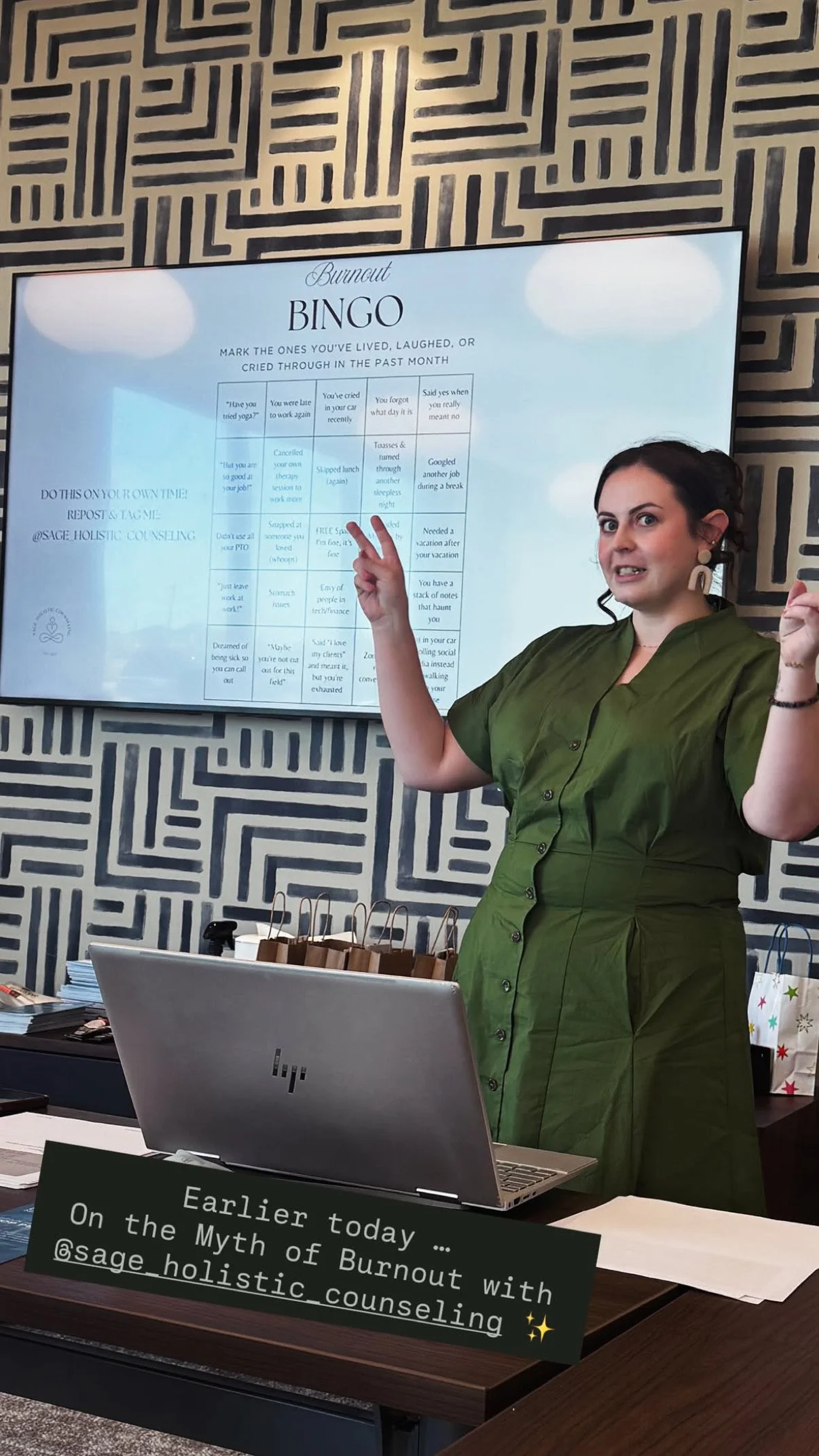
Burnout Myth Presentation Recap: The System is Broken, Not You

Burnout has long been misunderstood as a personal weakness. Helping professionals are advised to meditate more, take time off for vacations, and develop their resilience skills. In reality, that will never fix their burnout. Burnout is the result of impossible workloads, underfunded systems, and cultural expectations that demand constant giving without replenishment. If individuals are the cause and hold the solution for the burnout, then the exploiting and broken systems get to continue without having to change. For therapists and helping professionals, this narrative compounds guilt and makes recovery harder. When falsely placing the locus of control on the helping professional’s shoulders, narratives around ‘not being enough’ can trigger old, dysfunctional relationship patterns.

Read More
Aubrey Richardson Aubrey Richardson

Dear Patriarchy, Fuck You: How Domestic Violence and the Patriarchy Impact Women in Helping Professions

Women in helping professions—such as therapists, nurses, social workers, teachers, and caregivers—are often applauded for their compassion, emotional resilience, and selflessness. These female-dominated professions are typically centered around caring for others, providing emotional labor, and nurturing growth. But what is often overlooked is the profound impact of the f’ing patriarchy, in both the personal and professional areas, in making these women more susceptible to domestic violence.

Read More
Aubrey Richardson Aubrey Richardson

What Yoga Taught Me About Boundaries (That Therapy Confirmed)

What yoga taught me about boundaries, therapy confirmed: listening to your body is not indulgent in any way, it’s necessary in every way. Respecting your limits is not weakness; it’s a strength. And choosing to care for yourself, even when it’s inconvenient, is the most important boundary you can ever set.

If you’ve been pushing yourself past your edges in yoga, in work, or in relationships, consider this your invitation to pause. To modify. To breathe. To say yes to yourself. Because boundaries aren’t barriers. They’re bridges.

Read More
Aubrey Richardson Aubrey Richardson

Yoga Is More Than a Physical Practice: Honoring National Yoga Month

Yoga is more than movement. It’s a practice of connection to self, to others, and to the present moment. For therapists and caregiving professionals, it is one of the most accessible ways to regulate the nervous system, practice boundaries, and honor the truth that your well-being matters. So this National Yoga Month, may you step onto your mat not just to stretch your body, but to expand your capacity for care, starting with yourself.

Read More
Aubrey Richardson Aubrey Richardson

Crisis Resources in Dallas, Texas: Where to Find Immediate Support

When you’re in crisis, knowing where to turn can feel overwhelming. Whether you’re experiencing suicidal thoughts, navigating domestic violence, coping with grief, or supporting a loved one in need, resources in Dallas and across Texas are available right now to connect you with care and safety.

As a therapist in Dallas-Fort Worth, I know how vital it is to have a clear list of trusted crisis resources. This guide brings together local hotlines, national lifelines, and community-based support so you or someone you love can find immediate help.

Read More
Aubrey Richardson Aubrey Richardson

What If You’re Not Actually Lazy?

You’ve had the thought: “Why can’t I just get it together?”
The laundry’s not folded, your inbox is overflowing with tasks, and you’re staring at the ceiling wondering how you can feel so tired after doing so little.If you’re reading this and already judging yourself, calling yourself lazy, unmotivated, or not pulling your weight, I want to offer a different thought: What if you’re not actually lazy? What if you’re burned out, overwhelmed, and exhausted in a way that can’t be fixed by trying harder?

Read More
Aubrey Richardson Aubrey Richardson

Why You Feel More Anxious When Things Finally Slow Down

You’ve cleared your calendar. The emails can wait. You’ve snoozed all your to-do list items. You finally have a window of time, maybe an entire day, with no fires to put out. But instead of relief, something uncomfortable creeps in. A sense of guilt. Restlessness. You can’t sit still. You notice an anxious energy that hums just beneath the surface. You might find yourself scrolling, reorganizing, cleaning, or worst of all, spiraling into self-criticism.

Sound familiar? If you’re a therapist, caregiver, or helping professional, this experience isn’t just common; it’s baked into the emotional labor you carry and the toxic productivity culture we live in. Let’s unpack why rest doesn’t always feel restful and how to begin reclaiming your right to pause.

Read More
Aubrey Richardson Aubrey Richardson

The Quiet Grief of Perfectionism & People Pleasing: Naming the Losses

Healing from perfectionism and people-pleasing isn’t just empowering. It’s disorienting. Lonely. Grief-soaked. What most people won’t tell you is that letting go of these identities—especially when they’ve helped you survive—comes with loss. Quiet losses. Invisible ones. Losses that don’t get sympathy cards or casseroles dropped off at your door, but that cut deep all the same. Every change in our life, whether ‘good’ or ‘bad’, comes with both gains and losses.

If you’ve spent years shaping yourself into who others needed you to be, then healing isn’t just about setting boundaries and speaking up. It’s about grieving who you had to become in the first place, everything that gets shaken loose when you stop, and all the forgiving yourself for your past choices.

This is the part of the healing process that can’t be bypassed. And if you’re a therapist, caregiver, or lifelong overfunctioner doing the slow work of reclaiming yourself: I see you. I know you. This post is for you.

Read More
Aubrey Richardson Aubrey Richardson

How to Create a Sustainable Wellness Routine When Your Burnout is Soul Deep

If you’re a therapist, caregiver, or helping professional in Texas and you’re looking for therapy that honors just how deep this burnout, anxiety, and people-pleasing goes, welcome. I see you. Let’s talk about how to rebuild your wellness in a way that’s sustainable. Be gentle with yourself. And just bold enough to ask: ‘What would feel better than this?

Read More
Aubrey Richardson Aubrey Richardson

Burn Book: Therapist Self-Care Hour

At Sage Holistic Counseling, I specialize in burnout therapy in Texas and therapy for therapists in Texas, because I’ve seen firsthand how deeply our profession teaches us to perform wellness instead of actually experiencing it. We hold space. We carry crises. We stay calm when everyone else unravels. And eventually, if we’re not careful, we stop recognizing the difference between our job and our identity.

That’s why I created the Burn Book: Therapist Self-Care Hour, a free, virtual, drop-in space for therapists and helpers who are feeling crispy, overextended, and deeply human. This wasn’t your average networking event or CEU presentation. This was a sacred pause. A place to put something down without needing to explain it.

And the response? Overwhelmingly powerful.

Read More
Aubrey Richardson Aubrey Richardson

How to Rest This Summer (Even if You’re an Overachiever) Without Feeling Like You’re Falling Behind

If you are the kind of person who thrives on checklists, overbooks yourself into oblivion, and panics when your calendar has white space, then you already know rest does not come easily. Especially when your identity has been built around always being productive, available, and fine.

Let’s talk about what it means to rest this summer, without spiraling into guilt, shame, or financial panic. And yes, we’re going to get real about why rest feels unsafe, even when you’re running on fumes.

Read More
Aubrey Richardson Aubrey Richardson

Are You the Unpaid Therapist of Your Friend Group?

You might be surrounded by people, but still feel profoundly alone.

Because being needed is not the same as being seen. Being the one everyone turns to for emotional support doesn’t mean anyone actually knows what you need. And when you’ve spent years being the steady one, the reliable one, the “therapist” of the group, it can feel nearly impossible to ask for help.

Your relationships might feel one-sided. You may start to resent the people you love, not because they’re bad or selfish, but because you’ve trained them to come to you for care while expecting almost nothing in return.

And here’s the truth that might sting a little: the more you act like you don’t need anything, the more people will believe you.

Read More
Aubrey Richardson Aubrey Richardson

July is the Halfway Point: Time to Reset Before the Next Burnout Cycle Begins

July is here again. If you’re a therapist, caregiver, or natural-born helper, it probably snuck up on you while you were too busy juggling everyone else’s needs. You’ve already survived the chaos of “May-cember”,  those overwhelming last few weeks of the school year where every activity, celebration, and end-of-year obligation gets jammed into a single month. And now it’s summer, but nothing about it feels slower or more spacious. You’re still booked, still exhausted, still holding it all together for everyone else… without school or childcare to lighten the load. Does the vacation you scheduled even qualify as a vacation if you’re already stressed out by the packing and coordinating?

Read More