
What If You’re Not Actually Lazy?
You’ve had the thought: “Why can’t I just get it together?”
The laundry’s not folded, your inbox is overflowing with tasks, and you’re staring at the ceiling wondering how you can feel so tired after doing so little.If you’re reading this and already judging yourself, calling yourself lazy, unmotivated, or not pulling your weight, I want to offer a different thought: What if you’re not actually lazy? What if you’re burned out, overwhelmed, and exhausted in a way that can’t be fixed by trying harder?

Why You Feel More Anxious When Things Finally Slow Down
You’ve cleared your calendar. The emails can wait. You’ve snoozed all your to-do list items. You finally have a window of time, maybe an entire day, with no fires to put out. But instead of relief, something uncomfortable creeps in. A sense of guilt. Restlessness. You can’t sit still. You notice an anxious energy that hums just beneath the surface. You might find yourself scrolling, reorganizing, cleaning, or worst of all, spiraling into self-criticism.
Sound familiar? If you’re a therapist, caregiver, or helping professional, this experience isn’t just common; it’s baked into the emotional labor you carry and the toxic productivity culture we live in. Let’s unpack why rest doesn’t always feel restful and how to begin reclaiming your right to pause.

The Quiet Grief of Perfectionism & People Pleasing: Naming the Losses
Healing from perfectionism and people-pleasing isn’t just empowering. It’s disorienting. Lonely. Grief-soaked. What most people won’t tell you is that letting go of these identities—especially when they’ve helped you survive—comes with loss. Quiet losses. Invisible ones. Losses that don’t get sympathy cards or casseroles dropped off at your door, but that cut deep all the same. Every change in our life, whether ‘good’ or ‘bad’, comes with both gains and losses.
If you’ve spent years shaping yourself into who others needed you to be, then healing isn’t just about setting boundaries and speaking up. It’s about grieving who you had to become in the first place, everything that gets shaken loose when you stop, and all the forgiving yourself for your past choices.
This is the part of the healing process that can’t be bypassed. And if you’re a therapist, caregiver, or lifelong overfunctioner doing the slow work of reclaiming yourself: I see you. I know you. This post is for you.

How to Create a Sustainable Wellness Routine When Your Burnout is Soul Deep
If you’re a therapist, caregiver, or helping professional in Texas and you’re looking for therapy that honors just how deep this burnout, anxiety, and people-pleasing goes, welcome. I see you. Let’s talk about how to rebuild your wellness in a way that’s sustainable. Be gentle with yourself. And just bold enough to ask: ‘What would feel better than this?
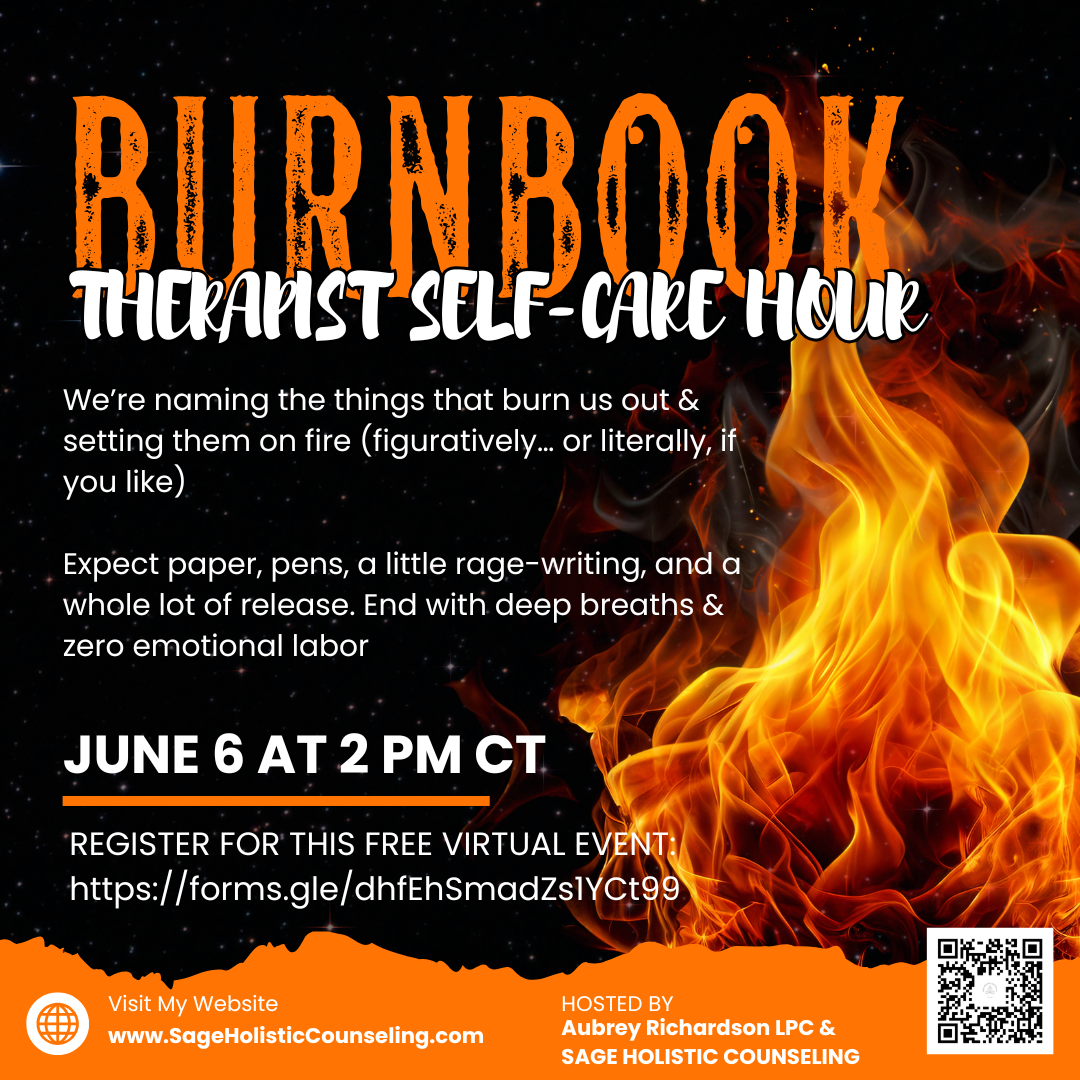
Burn Book: Therapist Self-Care Hour
At Sage Holistic Counseling, I specialize in burnout therapy in Texas and therapy for therapists in Texas, because I’ve seen firsthand how deeply our profession teaches us to perform wellness instead of actually experiencing it. We hold space. We carry crises. We stay calm when everyone else unravels. And eventually, if we’re not careful, we stop recognizing the difference between our job and our identity.
That’s why I created the Burn Book: Therapist Self-Care Hour, a free, virtual, drop-in space for therapists and helpers who are feeling crispy, overextended, and deeply human. This wasn’t your average networking event or CEU presentation. This was a sacred pause. A place to put something down without needing to explain it.
And the response? Overwhelmingly powerful.

How to Rest This Summer (Even if You’re an Overachiever) Without Feeling Like You’re Falling Behind
If you are the kind of person who thrives on checklists, overbooks yourself into oblivion, and panics when your calendar has white space, then you already know rest does not come easily. Especially when your identity has been built around always being productive, available, and fine.
Let’s talk about what it means to rest this summer, without spiraling into guilt, shame, or financial panic. And yes, we’re going to get real about why rest feels unsafe, even when you’re running on fumes.

Are You the Unpaid Therapist of Your Friend Group?
You might be surrounded by people, but still feel profoundly alone.
Because being needed is not the same as being seen. Being the one everyone turns to for emotional support doesn’t mean anyone actually knows what you need. And when you’ve spent years being the steady one, the reliable one, the “therapist” of the group, it can feel nearly impossible to ask for help.
Your relationships might feel one-sided. You may start to resent the people you love, not because they’re bad or selfish, but because you’ve trained them to come to you for care while expecting almost nothing in return.
And here’s the truth that might sting a little: the more you act like you don’t need anything, the more people will believe you.

July is the Halfway Point: Time to Reset Before the Next Burnout Cycle Begins
July is here again. If you’re a therapist, caregiver, or natural-born helper, it probably snuck up on you while you were too busy juggling everyone else’s needs. You’ve already survived the chaos of “May-cember”, those overwhelming last few weeks of the school year where every activity, celebration, and end-of-year obligation gets jammed into a single month. And now it’s summer, but nothing about it feels slower or more spacious. You’re still booked, still exhausted, still holding it all together for everyone else… without school or childcare to lighten the load. Does the vacation you scheduled even qualify as a vacation if you’re already stressed out by the packing and coordinating?

The Imperative of Supporting Private Practice Therapists Over Venture Capitalist Firms
As the landscape of mental health care evolves, the growing influence of venture capitalist (VC) firms in the therapy industry is a cause for concern. The allure of convenience and accessibility promised by digital platforms (whose names I will not say, because they like to sue people) masks a deeper issue: the commodification of therapy. To ensure the highest standards of care and uphold ethical practices, it is crucial to support private practice therapists over these profit-driven firms that have a history of putting profit over client rights and well-being. This not only preserves the integrity of the therapeutic profession but also bolsters local small businesses that are the backbone of our communities.
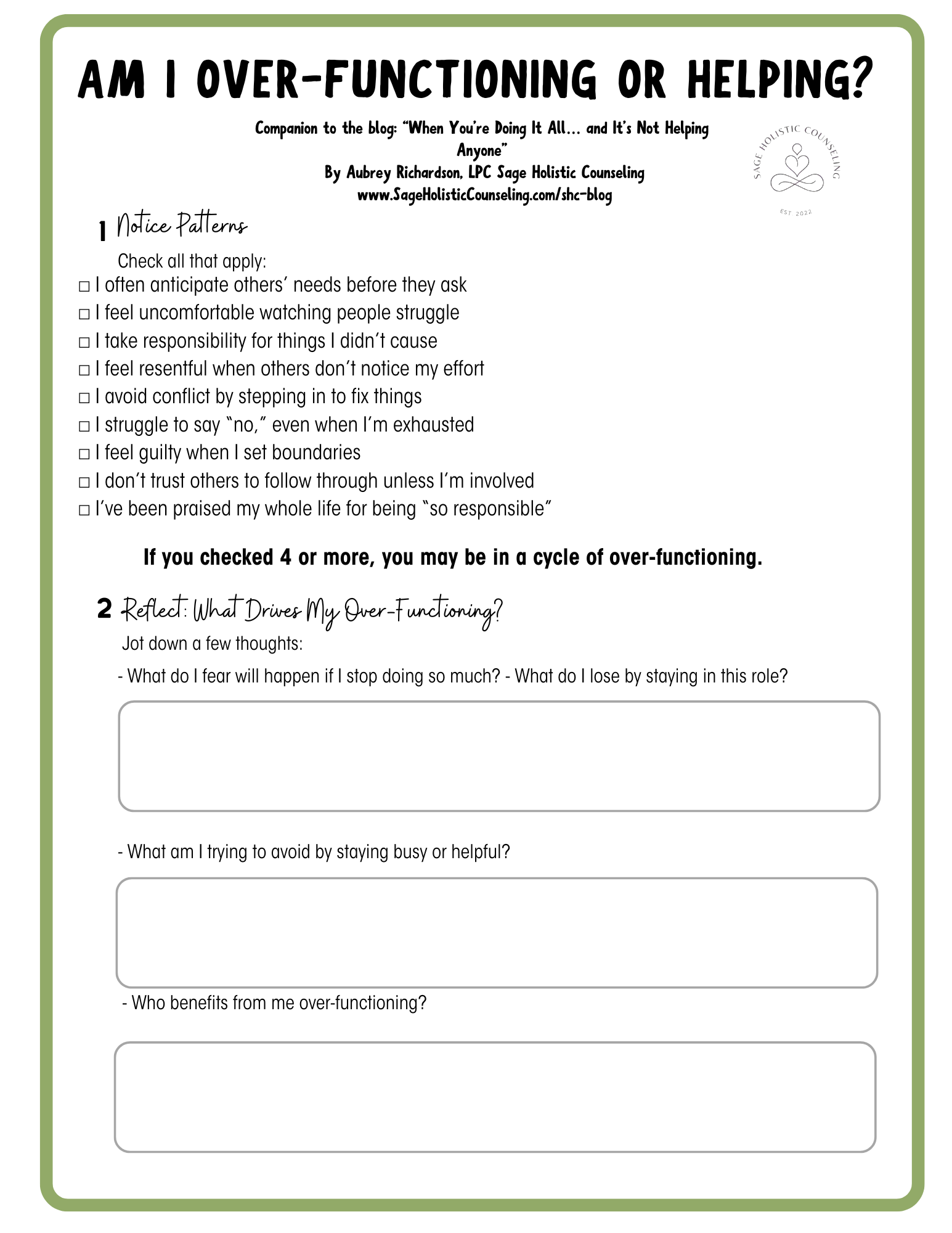
Are You Helping... or Enabling? A Worksheet for Overfunctioners
This worksheet is designed to help you slow down and ask: Am I helping? Or am I enabling? It’ll guide you through self-reflection prompts and boundary-setting practices you can actually use in your everyday life.

When You’re Doing It All… and It’s Not Helping Anyone
This post is especially for therapists, healthcare professionals, caregivers, and lifelong helpers who find themselves stuck in over-functioning patterns. If that’s you and you’re seeking therapy for therapists in Texas, know that you’re not alone, and you don’t have to stay in this cycle. In my work providing therapy for therapists in Texas, I see this all the time: smart, competent people caught in a loop of doing everything for everyone else, anticipating the needs of others, smoothing every rough edge. They see it as kindness. But when we look closer, we see that it’s actually keeping the people around them from taking responsibility for their own lives. And more than that? It’s slowly burning them out.

Why I’m No Longer Sold on ‘Recovering Perfectionist’
You’ve probably seen it in bios and captions, maybe even in mine: recovering perfectionist. It’s meant to be a wink to those who know, for those of us who have spent years trying to get things just right, who carry the weight of everyone’s expectations like it’s our full-time job. But lately, I’ve started to question the term. Not because I don’t relate to it. I do, 100%. But, because I think we need to talk more deeply about what “recovering” implies, who it is used to describe, and what that says about our current culture.

What I Wish I Knew My First Year Licensed as a therapist
Becoming fully licensed is a huge milestone and a huge adjustment. You go from having constant supervision and structured guidance to suddenly being "on your own," and while that independence can feel exciting, it can also feel overwhelming and isolating. No longer a “baby therapist”, but a full “adult therapist” with a shiny new license. But if you’re anything like I was, you quickly realize that licensure doesn’t come with a roadmap or a book with answers. Suddenly, you look around and realize that you are the therapist in charge of the room (how did I become the most adult in the room?), and you miss your supervisor. There’s so much I wish I had known that first year about managing my calendar, setting boundaries, and building a sustainable career. If you're just starting or have been practicing for a while, I hope these lessons help you skip some of the unnecessary stress. If anything, I hope you make your own mistakes and learn from mine.

The Silent Burnout of High-Functioning & Anxious therapists: Signs You’re Missing
High-functioning anxiety often wears a smile. It masquerades as productivity hacks, a full color-coded calendar, and a full bag of emergency supplies at all times—all signs that someone is allegedly thriving and “has it all together”. But behind the curtain of performance lies a persistent tension, an internal pressure cooker that never seems to release. For many helping professionals, especially therapists, this experience is familiar. You keep showing up. You keep giving. But under the surface, something feels off. The best metaphor: You act like a duck, swimming smoothly on the surface, but kicking like hell underneath the water.

Recognizing the Signs of Perfectionism: A Self-Assessment Guide
Everything always has to be just right.
Balanced. Timed perfectly. Handled without flaw.
But living like that? It’s exhausting.
And for many helpers and high-achievers, it’s not about aesthetics—it’s about survival.
Perfectionism isn’t just a personality quirk. It can be a trauma response. A way to feel in control, safe, or worthy in systems that reward overfunctioning and punish rest.
This week’s blog offers a self-assessment to help you gently explore the why behind your perfectionism—and how it’s showing up in your daily life

How to Break Free from the Perfectionism Trap
Perfectionism convinces you that everything needs to be just right—including you. But real connection doesn’t come from being flawless; it comes from being human. You don’t have to hold everything together to be worthy of rest, support, and care.

The Difference Between Helping and Self-Sacrificing
f you’re a natural giver, a helper, or someone who has spent a lifetime tending to the needs of others, it might feel like second nature to step in whenever someone needs you. You’re the one who anticipates problems before they happen, who offers support before it's requested, and who is so deeply attuned to the emotions of those around you that their struggles feel like your own. Helping is part of who you are. It’s a value you hold close. But at what point does helping shift from an act of kindness to an act of self-sacrifice? And when does that self-sacrifice become harmful?

Why Perfectionism Is Keeping You Stuck in the Helper Role
Perfectionism convinces you that balance means keeping everything perfectly aligned—never letting anything slip, always staying in control. But in reality, true balance isn’t about perfection; it’s about allowing yourself to rest, set boundaries, and accept that “good enough” is enough.

Ask Me Anything: Behind the Scenes with a Therapist
Ever wondered what inspired me to become a therapist, what challenges I love tackling, or what I’d be doing if I wasn’t in this field? I recently answered some of your burning questions in an AMA video, and let’s just say—you got me to spill!

How My Own Therapy Helps Me Be a Better Therapist
Let’s get something straight—I would never ask my clients to do something I wouldn’t be willing to do myself. Whether it’s sitting with discomfort, confronting hard truths, or actively working toward healing, I believe in practicing what I preach. That’s why I recently started my own EMDR therapy. Yes, even therapists need therapy. And honestly? It’s about time.