
Therapy for Therapists in Texas
I help therapists in Texas who are burned out, overextended, and tired of holding everyone else together get out of burnout cycles and stop overfunctioning through somatically informed EMDR and mindfulness-based online therapy.
ARE YOU PRIORITIZING YOU?
You hold space for others all day, every day. You guide, support, and nurture your clients through their deepest struggles while balancing finishing your notes in a 'reasonable' amount of time, drinking enough water (but not enough to have your bladder explode during a session), and trying to negotiate with insurance companies. Then, you drive home and want to collapse onto your couch scrolling social media. But, you don't feel like you can. Someone has to make dinner, start the tough conversations with your partner, and book the appointments. You find it hard to sleep and believe the entire weight of the world is resting on your heart and shoulders.
But who holds space for you? Your emotional load can be immense as a therapist, healer, and caregiver. You never thought you would be the person who dreads getting out of bed in the morning and shudders when hearing the ding of a new email detailing the latest client crisis. Each time you try to make a change or ask for help, it doesn't last for long, and you're exhausted from continuing to ask.
Most of my clients are wounded healers who genuinely want to help. But constantly putting others first isn’t sustainable. Therapy forces us to confront our martyr complex and prioritize our well-being. Therapy for therapists isn’t a luxury; it’s a necessity. At Sage Holistic Counseling, I specialize in helping therapists like you recover from the patterns that drain your energy so you can rediscover balance and joy in your personal and professional life.
Is it Supposed to Be this Hard?
Why Therapists Need A Specialized Therapist
The Emotional Toll of Holding Space
You’re deeply attuned to the needs of others, often prioritizing your clients’ well-being above your own. You know you can't keep going like this, you know the dangers of compassion fatigue, burnout, and isolation. You told yourself that you weren't going to be a therapist that felt dead on the inside. But, you're worried that no one understands the unique challenges of being a therapist inside and outside the therapy room.
The Pressure to Be Perfect
Therapists often grapple with high expectations: from clients, colleagues, supervisors, and themselves. You may have a stream of relentless self-criticism in your head, struggle with an overcommitted calendar, and have difficulty saying no—all of which take a toll on your mental health. Many of my clients wonder if they can even be a good therapist if they are struggling to manage their own life. My answer? Of course, it is possible.
See if this resonates: The Silent Burnout of High-Functioning & Anxious Therapists
Boundary Struggles
You might find it challenging to set and maintain boundaries, both at work and in your personal life. Perhaps you’ve noticed how saying “yes” to one more task at the end of a long day leaves you feeling stretched too thin. It’s not just about accommodating others…it’s the fear of letting someone down, or the pressure to prove your worth through overcommitment. Yet, constantly saying “yes” often means sacrificing your well-being, leaving little room for rest, reflection, or reconnecting with what truly matters to you.
The Stigma of Seeking Help
As a therapist, seeking therapy can feel like admitting failure. You might worry about being judged by peers or even fear that it could impact your referrals or business reputation. The stigma within the mental health field about clinicians seeking help themselves can amplify these fears, making it feel like an unspoken taboo. You might wonder if admitting your struggles means you’re not good at your job or question whether clients or colleagues will perceive you differently, especially if you are an early-career therapist. But seeking support isn’t a sign of weakness; it’s a courageous step toward resilience, growth, and ultimately becoming a more effective and balanced clinician.

My Approach & What makes me different
I create a space where you do not have to be the therapist in the room. You spend the rest of your day being okay for everyone else. In this hour, you do not have to pretend.
This is where we stop performing, overfunctioning, and holding everything together for everyone else. We start with what is actually happening right now: exhaustion, resentment, anxiety, and disconnection, and we tell the truth about it.
We are not just managing stress and symptoms. We are addressing the patterns that keep you stuck there. The perfectionism & relentlessness. The overcommitment. The constant pressure to be everything for everyone.
This work is about learning how to do less without everything falling apart. It is about setting boundaries that hold, tolerating the discomfort that comes with change, and building a life that does not require you to run on empty.
If this is you, these might describe your daily life:
Struggling to set boundaries without feeling guilty or selfish.
Constantly saying "yes" to requests, even when it means neglecting your own needs.
Feeling like you need to be perfect in every role you take on—therapist, partner, parent, friend.
Worrying about what others will think if you admit you need help.
Craving rest but feeling like you have to "earn" it.
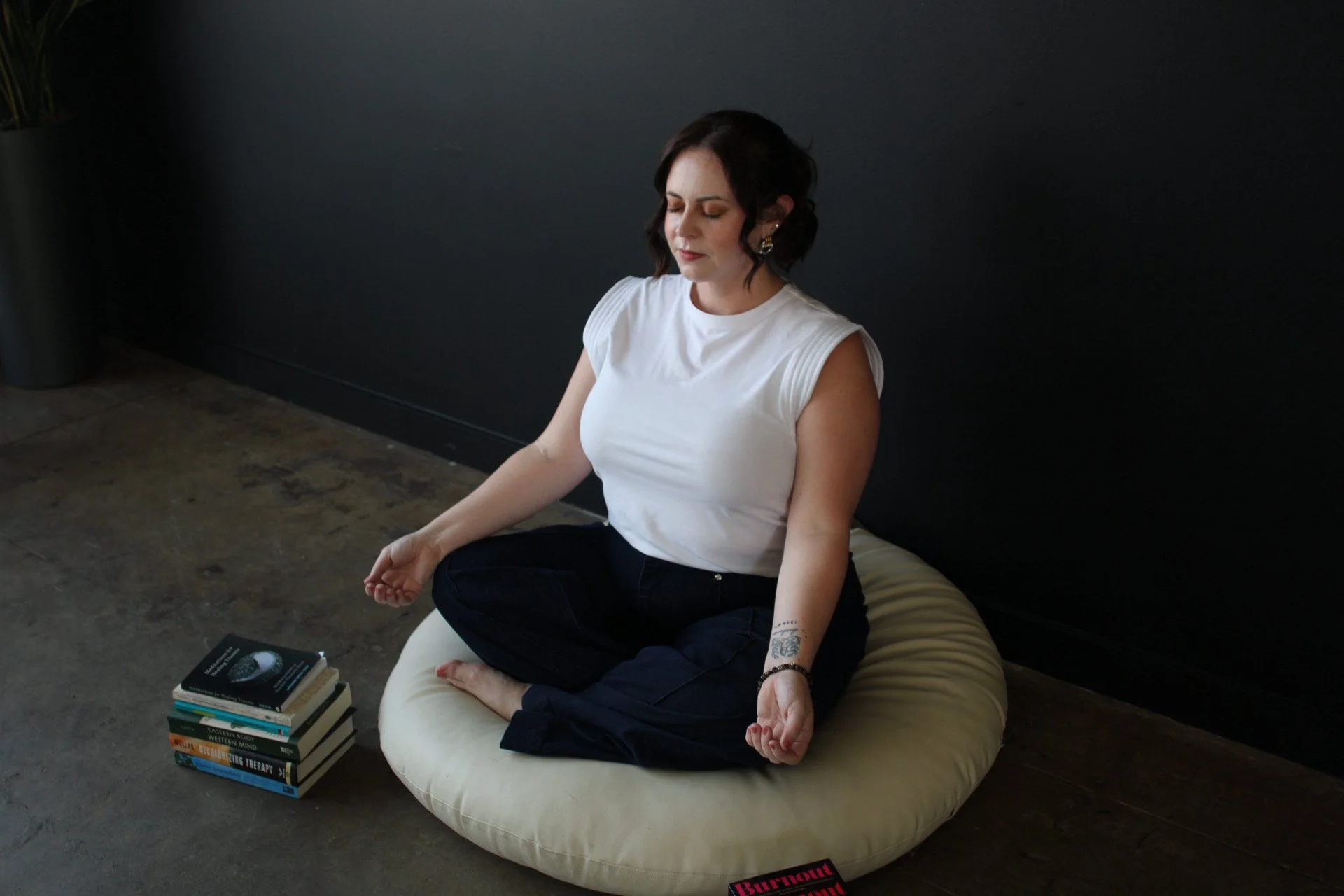
You already know how to show up for others.
This is where you learn how to do that for yourself.
Therapy for therapists:
THE MOST ASKED QUESTIONS
-
Because being the one who holds space for everyone else does not mean you do not need a place to fall apart.
Because you are not exempt you from burnout, resentment, or overwhelm. You need a space where you are not the therapist in the room.
Because knowing the tools does not mean you can use them on yourself.
If you want a deeper look at how this shows up, you can explore more on the blog.
I Will Die on this Hill: Therapists Should Be in Therapy
-
Because you are not treated like a colleague, a case, or someone who should already have it figured out. Therapy for therapists is not just therapy with more insight; it is therapy without the pressure to perform.
We focus on the patterns that come with being a helper like overfunctioning, perfectionism, andemotional overresponsibility without turning the session into supervision or making you explain your work.
You get to show up as a person, not a professional.
You are treated like a human who is exhausted from holding everything together.
You do not have to explain your job, defend your boundaries, or manage the person across from you.
-
Clients know me for my authenticity, directness, and my willingness to sit with them in the hardest moments of their lives. I am not afraid of the deep conversations. The ones about resentment, exhaustion, grief, identity shifts, and what happens when the person who holds everyone else together starts to fall apart.
Want to see my vibe? Check out my YouTube video: https://www.sageholisticcounseling.com/shc-blog/discover-the-sage-experience-what-its-like-to-work-with-me
Or, check out my Instagram to see my personality shine: https://www.instagram.com/sage_holistic_counseling
-
Feeling guilty for prioritizing your needs is common. Experiencing guilt doesn’t mean that you are making the wrong decision! It means that in a perfect world, you would have preferred to make another choice. Or, it may mean that you are taking on others’ suffering as your own and metabolizing it as your guilt. Let’s talk about it more during your next session.
-
Therapy is a commitment and an investment in your well-being. If you can’t find an hour once a week to prioritize yourself, then that is another symptom that we need to address. Together, we can address the barriers and pain points in prioritizing yourself as much as you prioritize everyone else.
-
I truly believe that all therapists should be in therapy and that you can only take your clients as far as you have gone yourself. Full stop.
Therapy does not just make us more insightful. It makes us more honest. More regulated. More aware of the places where we overfunction, avoid, or lose ourselves in the work.
When we have done our own work, we are less likely to:
rush to fix or rescue
avoid difficult emotions
overidentify with our clients
or carry what was never ours to hold
We become more grounded in the room. More present. More able to sit with what is actually happening without needing to control it.
And outside of the therapy room, it changes how we live.
We set better boundaries.
We tolerate discomfort without collapsing or overextending.
We stop running on empty and calling it dedication.So yes, therapy will make us better therapists.
But more importantly, it allows us to become people who are not quietly unraveling while holding everyone else together.
What THE WORK LOOKS LIKE WITH
AUBREY RICHARDSON, LPC & Sage Holistic Counseling
No performing. No overexplaining. No pretending you have it all together.
Therapy, especially as a therapist, is a different kind of work.
This is not a quick fix. It is a space where we slow down enough to actually see what is happening, untangle the patterns that keep you overextended, and begin building something more sustainable. Therapy is not just about solving immediate challenges; it’s about building lasting change and creating a life that feels sustainable and fulfilling.
In our sessions together, you can expect
A Safe Space to Be Vulnerable: Leave the role of “helper” at the door and step into a judgment-free zone where your feelings and struggles are honored. This is the one place where you don’t have to worry about the person across from you because I am solely focused on you, and I can take care of myself. Promise.
Evidence-Based Techniques: I integrate mindfulness, meditation, EFT/tapping, EMDR, DBT-informed therapy, and somatic approaches through a humanistic lens to address your unique challenges holistically. No pseudoscience or Tik-Tok Therapists are allowed here.
Permission to Prioritize Yourself: Therapy creates a dedicated time to focus entirely on you, without worrying about the next task or who needs your attention. You don’t need to be okay. Turn on your DND and mute your notifications. Our sixty minutes together is a sacred time to rest, feel, and heal.
Direct, honest conversations that go beyond surface-level coping and psychoeducation. Instead, we will focus on actually interrupting patterns of perfectionism and overfunctioning. We will challenge hustle culture, name the systemic forces that contribute to burnout, and help you reconnect with your capacity, community, and joy.
This work together takes time, intention, and practice. Some change will happen quickly; however, the deeper ones, the ones that actually change how you live and show up in your relationships and work, take consistency. Together, you can expect us to untangle the narratives that keep you overcommitted and stuck. But this is not about becoming a different person. It is about becoming someone who is no longer running on empty, quietly resentful, and holding everything together at their own expense.
Someone who can step back without everything falling apart.
Who can say no without the all-consuming guilt.
Who is no longer carrying what was never theirs to hold.
You spend your life showing up for everyone else.
This is where you start showing up for yourself. No more intellectualizing. No more overexplaining. No more self-abandoning.