Stop Waiting Until You're Desperate: Boundary Scripts for Women Who Are Tired of Being the Reliable One
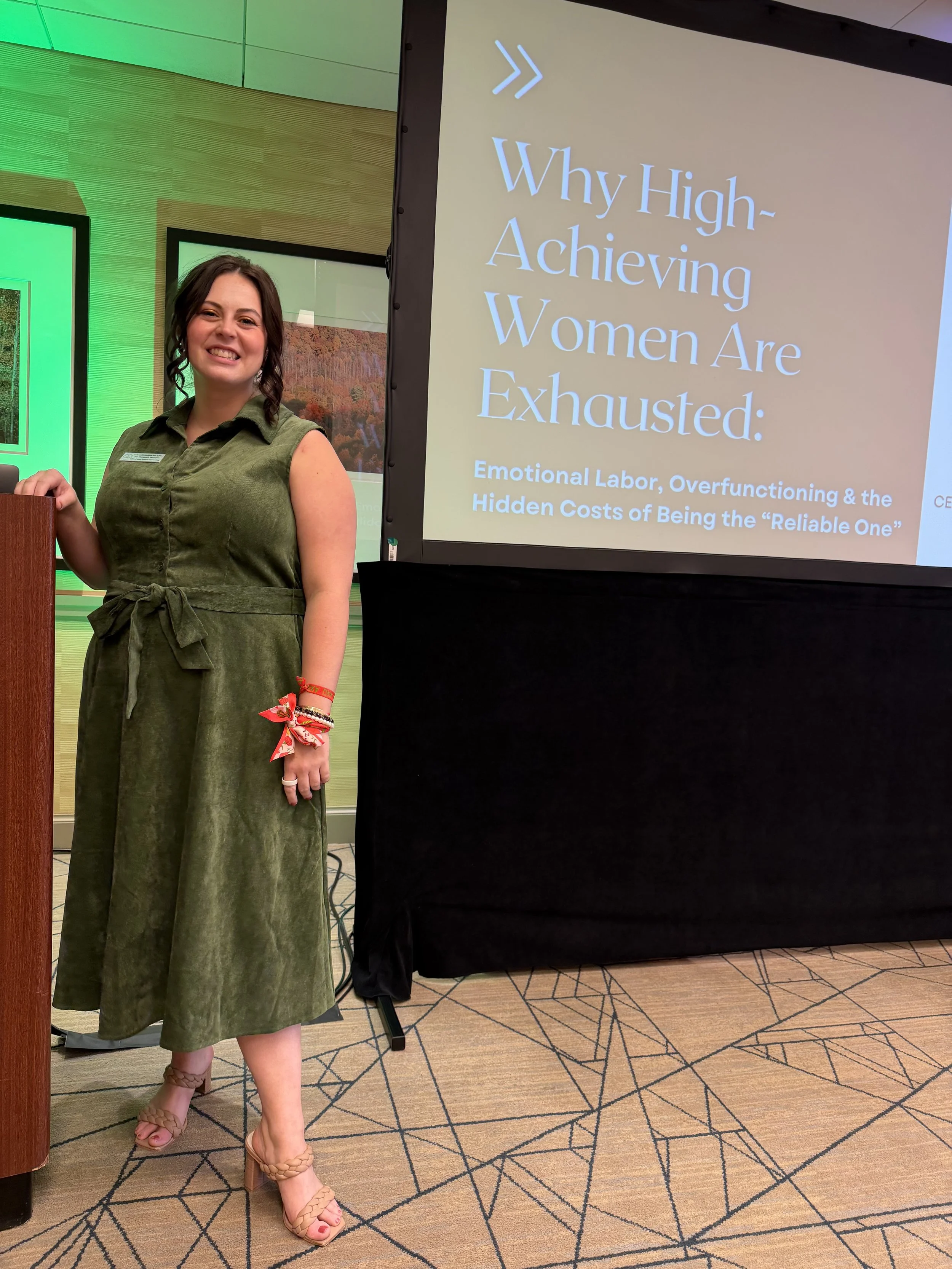
Burnout recovery doesn't begin with saying "no" more often. It begins by changing our relationship with vulnerability, control, and responsibility so we stop carrying what was never ours to begin with. This presentation explores why high achieving women become the reliable one and how boundaries create healthier, more sustainable relationships.
How many times have we rehearsed telling that one coworker our real thoughts …only to say, "Sure, I can get that done by EOD for you" with a smile when the moment actually arrived?
We tell ourselves it's easier if we just get it done, to tell ourselves we can actually handle everything on our plate and it’s actually harder if we stop to ask for help. We tell ourselves we will rest “once everything calms down”. Except, life never calms down.
For many high achieving women, burnout happens because we've become so practiced at abandoning ourselves that saying yes feels automatic. We have been too strong for too long. We’ve been the automatic yes-woman. And, your identity as the “reliable one” stems from learning to prioritize connection and manage (emotional) chaos to feel safe. When we’re tired of being endlessly dependable and responsible, setting limits and boundaries can feel like we don’t care at all. But in reality, we are no longer sacrificing ourselves to fix systemic gaps in responsibility.
Before We Learn Boundary Scripts, We Have to Change the Way We Think About Boundaries
When people ask me how to get better at setting boundaries, they're often hoping I'll hand them the perfect script. And I will, eventually because scripts are incredibly helpful.
But, they're not where I recommend we start.
Because the biggest obstacle to setting boundaries usually isn't a lack of words. It's a relationship with ourselves that has been shaped by overfunctioning, people pleasing, and the belief that our value comes from how much we can carry.
Before we change what we say to other people, we have to change what we believe about vulnerability, control, and responsibility.
That's where real burnout recovery begins.
Step One: Take Inventory Before Taking Action
Before setting a single boundary, I encourage people to have an honest conversation with themselves.
Not the conversation about what everyone else needs.
The conversation about what you need.
Many of us have become so accustomed to anticipating everyone else's needs that we've stopped noticing our own. We know who needs a ride, who forgot the deadline, who is struggling emotionally, and who needs another reminder. But if someone asked us what we need today, many of us would have to stop and think. Unfortunately, this isn't because we're incapable of knowing ourselves, it's because we've spent years practicing awareness of everyone else.
So, before we start changing our relationships to others, we need to take an honest inventory of our own needs and capacity.
Ask yourself:
What am I carrying that no one else sees?
What am I doing that someone else is capable of doing?
Where am I being over responsible?
What people, places, or things consistently drain my energy?
What am I afraid would happen if I stopped doing so much?
What would make my life just 1% easier this week?
These questions aren't about judging ourselves. They're about becoming aware.
Awareness allows us to see the invisible emotional labor, mental load, and overfunctioning that have quietly become our normal. Because we cannot change patterns we haven't acknowledged.
Changing Our Relationship with Vulnerability, Control, and Responsibility
As we begin taking inventory, three themes often emerge.
The first is vulnerability.
Many of us would rather overwork than admit we need help. We'd rather quietly struggle than risk disappointing someone. Vulnerability asks us to acknowledge that we have limits, needs, and capacity just like everyone else.
The second is control.
Overfunctioning often gives us the illusion that if we just keep doing more, anticipating more, and fixing more, we can prevent discomfort for ourselves and everyone around us.
But boundaries are not about controlling other people's behavior. They're about being honest about our own.
The third is responsibility.
This is where so many high achieving women get stuck.
Somewhere along the way, many of us began confusing having responsibilities to other people with being responsible for other people.
Those are not the same thing.
Unless we are caring for children who are not yet developmentally capable of managing these things themselves, we are only responsible for our own thoughts, our own feelings, and our own behaviors. We certainly have responsibilities to other people. We can be dependable, compassionate, and supportive. But we are not responsible for managing another adult's emotions, preventing their disappointment, solving every problem, or making sure everyone is comfortable all the time.
We can care deeply about someone without carrying what belongs to them.
That distinction changes everything.
Step Two: Share Your Capacity Honestly
Once we've gotten honest with ourselves, the next step is getting honest with other people.
This is where boundaries begin.
Notice I didn't say confrontation.
I didn't say ultimatums.
And I definitely didn't say control.
Healthy boundaries are an invitation into honesty.
They are simply the practice of communicating our needs, our limits, and our capacity with clarity and respect.
One of my favorite reminders is this:
Clarity is kindness.
When we avoid honest conversations to protect someone else from temporary discomfort, we often create long term resentment instead.
Clear expectations give relationships the opportunity to become healthier, not harder or more resentful.
Another definition I often return to is this:
Boundaries are the distance at which we can love ourselves and another person safely.
They're not walls designed to keep people out. Instead, boundaries are guidelines that protect the relationship by protecting the people within it.
In many ways, boundaries are simply the rules we teach other people about how we want to be treated. Not through demands, but through consistency.
Because every time we say yes when we mean no, rescue someone who could solve their own problem, or sacrifice our wellbeing to keep the peace, we're teaching people what they can continue to expect from us. Likewise, every time we communicate our capacity honestly, we begin teaching something new.
Equal Relationships Require Vulnerability
There is one more piece that doesn't get talked about enough.
Healthy, equal, and equitable relationships require vulnerability. Not just the vulnerability of sharing our feelings, but the vulnerability of asking for what we need without knowing whether we're actually going to receive it.
When we've spent years overfunctioning, asking can feel far more uncomfortable than simply doing it ourselves. If we ask our partner to help, they might forget. They might say no. They might do it differently than we would. They might not recognize the urgency that we feel. They might disappoint us.
That uncertainty is exactly why so many of us continue carrying everything ourselves. Overfunctioning often becomes a strategy for avoiding vulnerability or uncomfortable feelings like disappointment.
If we never ask, we never have to risk hearing no. If we do it ourselves, we never have to tolerate waiting, uncertainty, or unmet expectations. But healthy relationships are built on the willingness to take that risk.
They require us to say, "Here's what I need," while accepting that another person still has autonomy. They get to choose how they respond. They may meet the need beautifully. They may struggle. They may forget. They may need reminders. They may show up in a way that looks different from how we would have done it ourselves.
And sometimes, despite our best efforts, our needs may continue to go unmet.
That possibility is painful. But it is also clarifying.
Because boundaries aren't just about asking for different behavior. They're also about paying attention to the response.
When someone consistently demonstrates that they are unwilling or unable to participate in a relationship that feels mutual, respectful, and sustainable, we may have difficult decisions to make. Sometimes that means changing the relationship. Sometimes it means creating more distance. Sometimes it means grieving what we hoped the relationship could become.
Not every relationship can become reciprocal simply because we've started communicating more clearly.
The goal isn't to control someone into meeting our needs. The goal is to communicate our needs with honesty, observe what happens next, and trust ourselves enough to make decisions that protect our wellbeing.
Because healthy relationships are not built on one person carrying all the responsibility. They are built on two people who are both willing to be vulnerable, take responsibility for themselves, and contribute to the relationship in ways that are as equal and equitable as their circumstances allow.
Three Types of Boundary Scripts That Actually Work
Once we've done the deeper work of understanding our own needs, the words become much easier.
Not every situation requires a level ten boundary.
Sometimes we simply need language that creates enough space to stop abandoning ourselves. The worksheet organizes boundary scripts by different levels of intensity so we can respond thoughtfully instead of automatically saying yes.
1. Create Space
Sometimes we don't need a lengthy explanation.
We simply need permission to pause.
Instead of immediately saying yes, we might say:
"I'd love to, but I don't have the capacity."
"Thank you for thinking of me, but my plate is full."
"I'm not available for that."
"I'll have to pass."
Notice what's missing.
No apology.
No elaborate justification.
No five paragraph essay explaining why we're allowed to have limits.
2. Redistribute Responsibility
Many high achieving women aren't just carrying their own responsibilities.
They're carrying everyone else's, too.
Sometimes the healthiest response isn't saying no.
It's sharing the load.
That can sound like:
"I need support with this instead of handling it alone."
"I've noticed I've been carrying a lot of this responsibility, and I need us to redistribute it."
"What would it look like for this to feel more balanced?"
Healthy relationships don't require one person to hold everything.
3. Interrupt the Pattern
Some dynamics won't change until we stop participating in them.
If we've always been the rescuer, fixer, or emotional manager, people may continue expecting us to play that role.
Interrupting the pattern might sound like:
"I'm no longer available to manage this for everyone."
"I've been carrying more than my share, and I'm done doing that."
"I will continue participating, but not in the same capacity as before."
This isn't punishment.
It's sustainability.
The Real Work Begins After We Set the Boundary
Here's what almost nobody talks about.
The hardest part of boundaries usually isn't saying the words.
It's tolerating what comes next.
After we set a boundary, we might notice:
Guilt
Anxiety
Restlessness
The urge to over explain
Worry that someone is upset
Thoughts like, "Maybe I should just do it myself."
Many people assume those feelings mean they've made the wrong decision.
Often, they simply mean they're doing something different.
As the worksheet reminds us, discomfort isn't necessarily a sign that something is wrong. More often, it's evidence that we're interrupting old patterns and creating new ones. It encourages us to name the feeling, notice what our body is doing, ground ourselves, and allow the emotion to move through us without rescuing or fixing.
The goal isn't to eliminate discomfort.
The goal is to survive it without abandoning ourselves.
The Boundary That Changes Everything
If there is one belief I hope we leave with, it's this:
Our capacity is not a community resource.
That sentence isn't selfish.
It's honest.
Because burnout recovery isn't about becoming less generous.
It's about becoming sustainable enough that our generosity becomes a choice instead of a survival strategy.
When we stop measuring our worth by how much we can carry, something remarkable happens.
We finally have room to carry ourselves.
Therapy isn't about becoming less caring. It's about becoming so deeply rooted in your own needs, values, and capacity that caring for others no longer requires abandoning yourself. Together, we'll untangle the patterns of people pleasing, overfunctioning, and emotional responsibility that have kept you exhausted, so you can build boundaries that feel honest, sustainable, and aligned with the life you actually want to live.
Schedule your free 15 minute consultation:www.SageHolisticCounseling.com/booking
Explore my full knowledge bank on burnout recovery, boundaries, and overfunctioning:www.SageHolisticCounseling.com/shc-blog