When Self-Care Isn’t Working: Why Community Care Might Be the Missing Piece
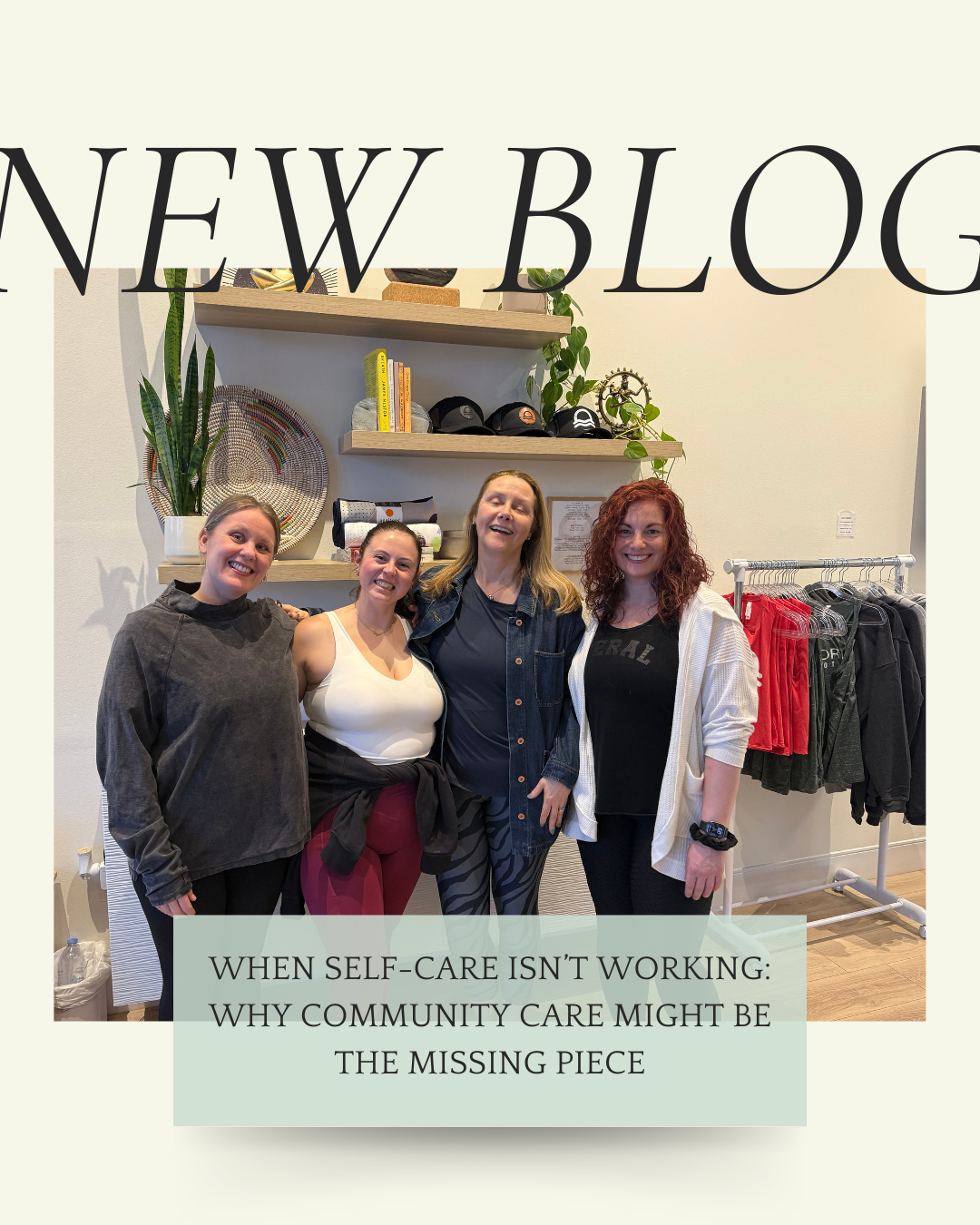
Sometimes burnout recovery is not about finding another way to take care of ourselves. It is about letting ourselves be cared for, sharing responsibility, and recognizing that being capable of carrying something does not automatically make it ours to carry.
We’ve tried taking better care of ourselves. Maybe we’re getting more intentional about sleep, going to yoga, taking the occasional mental health day, journaling, setting boundaries, drinking enough water, or making ourselves put the laptop away at a reasonable hour.
Some of it probably helps. And yet, we’re still exhausted.
Not necessarily sleepy like we need a nap, but bone tired. The kind of tired that comes from being responsible for too many things for too long. We’re remembering the appointments, checking in on the people we love, figuring out dinner, noticing what needs to happen next, keeping up at work, managing the logistics, and trying to make sure nobody falls through the cracks.
When we finally realize we’re running on empty, the natural response is often to wonder: What other self care can I try?
But if we’ve been Googling that question over and over again in the middle of the night or while sitting in the driveway trying to gather enough energy to go inside the house, I’d like to offer a different one:
What if we don’t need another way to take care of ourselves? What if we need more opportunities to be cared for, too?
When Self Care Is Not Enough for Burnout Recovery
When self care isn’t working, the answer may not be adding another coping strategy to our routines. Sometimes burnout recovery requires reducing what we’re carrying and allowing other people to help carry some of it with us.
A simple place to start is to ask:
What would make my life 1% easier tomorrow?
Then we have to resist the urge to immediately turn the answer into another task for ourselves. Sometimes the answer is something we can do. Sometimes it’s something we can stop doing. And sometimes the answer requires another person to show up.
That shift from How can I take better care of myself? to How can we care for ourselves and each other more fully, in ways that include being supported and also showing up for others in return? is where community care begins.
Self Care Matters. It Just Has Limits.
I am not anti self care. Quite the opposite.
Rest matters. Nourishment matters. Movement matters. Boundaries matter. Doing something simply because we enjoy it matters. Taking time away from our responsibilities can give our bodies and brains a much needed opportunity to recover.
The problem is what happens when we start treating self care as the solution to every kind of exhaustion.
Self care can help us prepare for and recover from the demands of our lives, but it cannot necessarily change the demands themselves. A meditation might help us feel more grounded before a stressful day, but it cannot make an unreasonable workload reasonable. A yoga class might help us reconnect with our bodies, but it cannot redistribute the invisible labor in our households. A bath might feel wonderful at the end of a long week, but it cannot give us back the hours we spent managing everyone else’s needs.
This distinction matters when we talk about burnout recovery, especially for caregivers, high achievers, helping professionals, and people experiencing therapist burnout. When the problem is too much responsibility, too little support, or a system asking for more than one human being can sustainably give, another coping skill cannot fix the underlying systemic problem.
The Cost of Treating Burnout Like a Personal Failure
When someone is already overwhelmed, constantly prescribing more self care can accidentally create another responsibility while reinforcing the false idea that burnout is an individual problem.
Now, in addition to everything else, we’re supposed to meal prep, meditate, exercise, journal, maintain a morning routine, practice gratitude, get eight hours of sleep, drink enough water, and maintain boundaries to successfully “fill our own cup.” And if we cannot keep up with all of that, we may start to believe our exhaustion is our own fault.
That is where the conversation about self care can become actively unhelpful.
We start asking, What’s wrong with me? Why can’t I handle this better? Why does everyone else seem capable of keeping up?
Meanwhile, the actual problem may be chronic overwork, unequal emotional labor, caregiving responsibilities, people pleasing, overfunctioning, financial pressure, a lack of practical support, or simply more responsibility than one person can sustainably carry. Burnout is a systems level problem that requires a system level solution.
So, we probably aren’t failing.
More likely, we are trying to solve too many problems in a system that gives too little.
And if we keep responding to overload by trying to become even better at carrying it, the cost is not just exhaustion. We lose time, relationships, pleasure, physical capacity, and connection with ourselves. We can become resentful of people we love while simultaneously feeling guilty for that resentment. We may become so accustomed to overriding our own needs that we no longer notice them until our bodies or emotions force us to.
The goal of burnout recovery cannot simply be getting better at tolerating an impossible amount.
Community Care Means We Do Not Have to Carry Everything Alone
Community care is based on a very simple idea: our well being was never meant to be an entirely individual project.
We take care of ourselves, but we also care for one another. We build relationships and communities where support, responsibility, attention, and effort can move in more than one direction.
For those of us accustomed to being the reliable one, that second part can be surprisingly difficult.
We may be excellent at noticing when someone else needs help. We remember the birthday, send the check in text, research the doctor, bring dinner, volunteer to drive, make the reservation, solve the logistical problem, and notice that everyone is getting overwhelmed before they even have to tell us.
But when we are overwhelmed, we may become remarkably good at explaining why we shouldn’t need anything.
They already have a lot going on.
It’s easier if I just do it.
I don’t want to inconvenience anyone.
It’s not really that big of a deal.
I can handle it.
And we probably can handle it. We’ve handled an enormous amount already.
But being capable of carrying something does not automatically make it ours to carry.
That is one of the places community care asks us to get curious.
What Does Community Care Actually Look Like?
The phrase community care can sound big. It can bring to mind mutual aid, community organizing, neighborhood networks, or large systems of collective support, and those things absolutely matter.
But community care also happens in very ordinary moments.
It happens when a partner notices we’ve hit our limit and handles dinner without needing detailed instructions. It happens when a friend sits with us while we make the phone call we’ve been avoiding. It happens when someone picks up our kid, drops off groceries, sends us the name of the contractor they already researched, or lets us say, “I’m having a terrible week,” without immediately asking us to make them feel better about it.
It can also mean changing the way responsibilities operate in our relationships so that we aren’t perpetually the person who notices, delegates, remembers, plans, and follows up. Community care is not about finding someone to rescue us. It is about challenging the assumption that adulthood requires complete self sufficiency. We are interdependent people. We function within friendships, families, partnerships, workplaces, neighborhoods, and communities. There are supposed to be times when we carry someone else, times when they carry us, and plenty of times when we carry something together.
Why Receiving Care Can Feel Harder Than Giving It
For people who have spent years being competent, reliable, thoughtful, and attuned to everyone around them, receiving care can feel much more vulnerable than providing it. We might understand perfectly well that we are “allowed” to ask for help and still find ourselves thinking, No, no, I’ve got it.
That pattern usually didn’t come from nowhere.
Maybe being useful became part of how we learned to connect with other people. Maybe anticipating everyone’s needs helped things run more smoothly in our families. Maybe asking for help historically created more work than doing it ourselves. Maybe we’ve been praised for being independent for so long that needing someone now feels strangely uncomfortable.
Overfunctioning can even feel like safety because doing everything ourselves allows us to maintain control. Asking another person to participate introduces uncertainty. They might say no. They might forget. They might do it differently than we would. They might disappoint us.
Community care requires some vulnerability because equitable relationships require us to ask for what we need without knowing exactly how the other person will respond.
That discomfort does not necessarily mean the boundary, request, or redistribution of responsibility is wrong. It may simply mean we are doing something different.
What Would Make Your Life 1% Easier?
When we are already burned out, “change your life” is not particularly useful advice.
One percent is different.
One percent does not require a new morning routine, a dramatic confrontation, or a complete overhaul of the household systems by next Tuesday. It simply asks us to identify one small point of friction and consider whether it could be reduced.
Maybe tomorrow would be easier if someone else figured out dinner (may I suggest the therapist snack plate or we order take-out).
Maybe it would be easier if we moved the nonurgent appointment instead of squeezing it into an already packed day.
Maybe it would help to tell a friend, “I don’t need advice. I just really need someone to listen for ten minutes.”
Maybe it would help if we ask our neighbors for an errand exchange. You pick up their groceries while you are out if next week they can take your returns to the store.
Or maybe tomorrow would be 1% easier if something could simply be good enough.
Those changes sound small because they are small. That’s the point. When we have spent a long time overfunctioning, practicing community care does not have to begin with suddenly becoming comfortable asking everyone for everything.
It can begin with making life slightly easier and questioning the belief that we have to be the one who makes that happen.
10 Ways to Make Life Easier by Next Week
This is not a challenge to complete all ten. Please do not turn an article about carrying less into another checklist we have to excel at.
Instead, read through these and notice whether one makes your shoulders drop a little.
Ask someone to completely own one task. Not “help” while we continue planning, delegating, and following up. Let someone else be responsible for dinner, the reservation, the phone call, the grocery order, or whatever else needs doing.
Cancel, postpone, or decline one nonessential thing. Look at the next seven days and identify something that is there primarily because we feel like we should do it.
Lower the standard somewhere. Dinner can be sandwiches. The birthday gift can be a gift card. The email can be three sentences. The house can look like people live there. Not everything requires our maximum effort.
Ask for one specific kind of support. “Can you handle dinner tonight?” is easier for someone to respond to than “I need more help.” So is, “Can I complain for ten minutes without us trying to solve it?”
Don’t immediately solve the next problem someone mentions. Give the problem a moment before researching, scheduling, fixing, volunteering, or offering a solution. See what happens if it is allowed to exist without immediately becoming ours.
Tell someone the truth about how we’re doing. We don’t have to tell everyone everything, but we can experiment with replacing an automatic “I’m fine!” with “Honestly, I’m pretty depleted this week.”
Let someone do something nice without immediately reciprocating. Accept the meal, ride, favor, compliment, or help without mentally adding it to a ledger that needs to be balanced by tomorrow.
Sort what we’re carrying into three categories: mine, ours, and theirs. We may discover that some of the things taking up the most space in our brains don’t actually belong entirely, or at all, to us.
Do something today that Future You will appreciate. Put the medication next to the coffee maker. Move the appointment. Order the groceries. Put what we need by the door. Small acts of care still count.
Ask the 1% question. At the end of the day, ask, What would make tomorrow 1% easier? Then consider whether the answer requires doing more or whether it might be an opportunity to carry less.
You Do Not Need to Get Better at Carrying Everything
Therapy can be a place to get curious about why we have become responsible for so much without turning those patterns into another thing that is wrong with us.
We can look at what happens internally when we consider putting something down, why people pleasing or overfunctioning makes receiving support uncomfortable, how our boundaries have been shaped by our relationships, and what being genuinely supported could look like in the lives we actually have.
Because the goal is not to make us better at tolerating an impossible amount.
Sometimes the work is learning that we can ask for help. We can receive care. And we do not have to solve our exhaustion entirely on our own.
If you are tired of being the person who holds everything together, you do not have to figure out how to change that by yourself either. Schedule a consultation with Sage Holistic Counseling and let’s talk about what carrying less could actually look like for you.
Learn more and read additional resources at www.SageHolisticCounseling.com/shc-blog.
—--------- (add dividing line)
Frequently Asked Questions About Self Care and Community Care
Why isn’t self care helping my burnout?
Self care can help us recover from stress, but it cannot always remove the circumstances creating that stress. If exhaustion is connected to chronic overwork, caregiving, emotional labor, relationship dynamics, therapist burnout, or carrying too much responsibility, burnout recovery may require both individual coping strategies and changes to the amount of support and responsibility in our lives.
What is community care?
Community care is the practice of supporting one another rather than treating well being as an entirely individual responsibility. It can include emotional support, practical help, shared responsibilities, mutual aid, caregiving, and relationships where giving and receiving care can move in both directions.
What’s the difference between self care and community care?
Self care focuses on the ways we care for our own physical, emotional, and psychological needs. Community care recognizes that some needs are better met collectively and that other people can play an important role in our well being. The two are not opposites. Most of us need both.
How do I ask for help when I’m used to doing everything myself?
Start small and specific. Instead of waiting until we’re completely overwhelmed or asking someone to “help more,” we can identify one concrete thing another person could do. That might mean asking someone to handle dinner, make a phone call, take ownership of an errand, or simply listen. Receiving small amounts of support can help us practice tolerating the vulnerability of not doing everything ourselves.
Can community care help with burnout recovery?
Community care can be an important part of burnout recovery when exhaustion is connected to carrying too much responsibility with too little support. It does not eliminate the need for rest, boundaries, or individual care, but it can help redistribute practical and emotional labor so recovery does not become another responsibility we have to manage alone.