10 Somatic Exercises for Exhaustion: Gentle Ways to Help Your Nervous System Recover
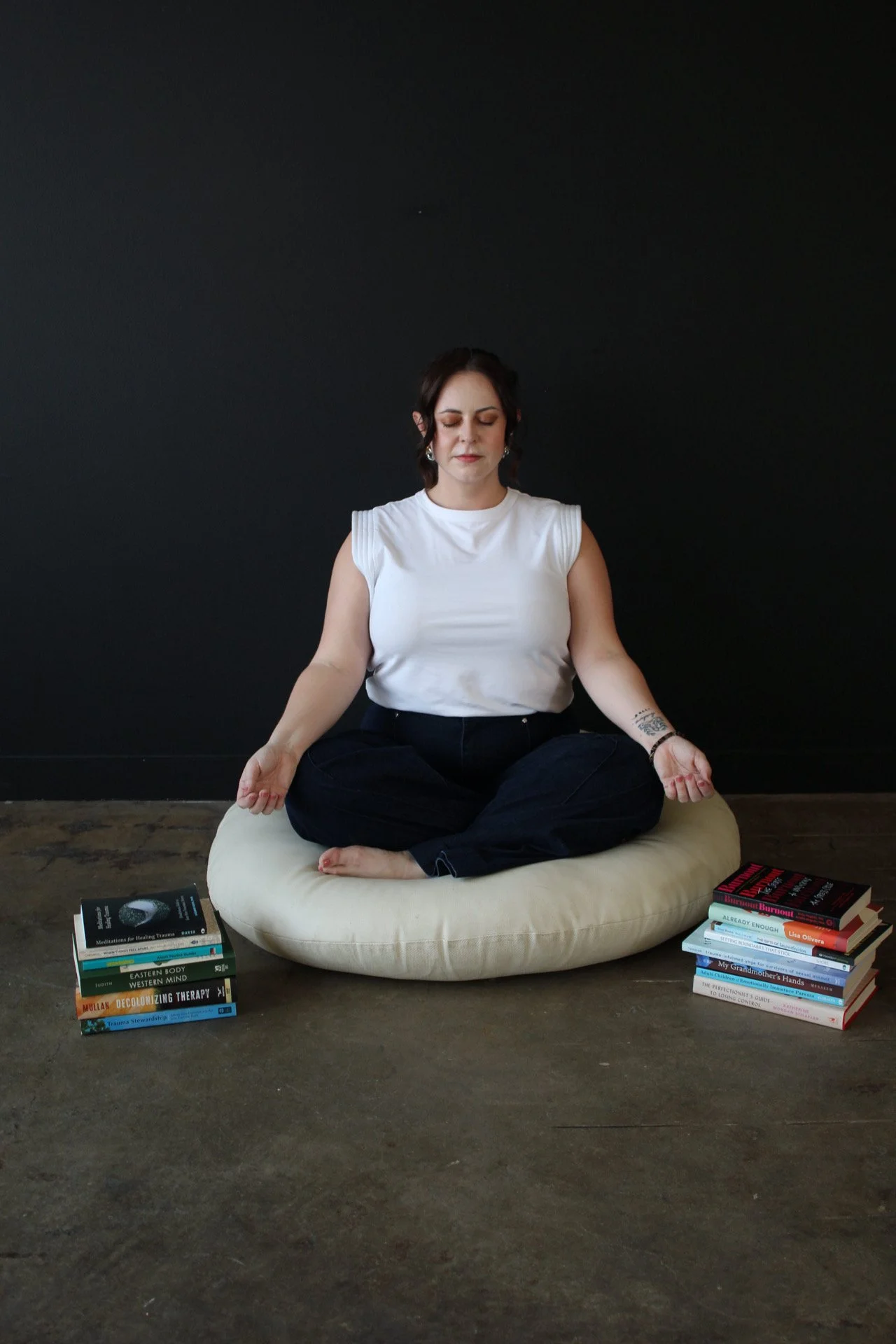
Sometimes nervous system regulation is about helping our bodies move through stress. Sometimes it is about slowing down long enough to hear what our exhaustion has been trying to tell us.
Sometimes we know we're tired.
Our bodies just haven't gotten the memo that they're allowed to stop.
We sit down, but we're still bracing. We get into bed, but our brains are already running through tomorrow's list. Our jaws are tight, our shoulders are somewhere near our ears, and our breathing feels shallow. Somehow, we're completely exhausted and still very much on.
That combination can be particularly familiar for therapists, caregivers, high achievers, and people who have spent a long time overfunctioning. We become exceptionally skilled at pushing through, tending to other people's needs, and overriding our own signals because something else always seems more urgent.
Eventually, being tired doesn't automatically mean being able to rest.
This is where somatic exercises can be helpful. Not because we need ten more things to add to our wellness routine. And definitely not because we should become so good at nervous system regulation that we can tolerate any amount of stress (impossible in case you were wondering).
Somatic exercises are tools for noticing, processing, moving, connecting, and sometimes finding a little relief. They can help us hear our bodies more clearly. And sometimes what our bodies have to say is not, Try harder to relax. Sometimes it's: I cannot keep doing this.
What Are Somatic Exercises for Exhaustion?
Somatic exercises are practices that use body sensations, breathing, movement, touch, awareness, and connection to help us notice and respond to what is happening physically and emotionally in the present moment.
When we're exhausted but have difficulty slowing down, these practices can create opportunities for grounding, movement, connection, emotional processing, and relief.
They may be useful as part of burnout recovery, emotional regulation, or somatically informed therapy because they shift some of our attention away from endlessly thinking about how stressed we are and toward noticing how stress is actually showing up in our bodies.
But there is an important distinction we need to make.
Somatic exercises can help us process and find relief. They cannot solve our entire lives.
We cannot breathe our way out of an unreasonable workload.
We cannot tap our way into having fewer caregiving responsibilities.
We cannot ground ourselves enough to counterbalance the effects of chronic sexism, racism, fatphobia, etc.
And we cannot regulate our nervous systems into no longer needing rest, boundaries, nourishment, support, or meaningful change.
What Can Somatic Exercises Help With?
Depending on the person and the moment, somatic exercises may help us:
Notice what is happening inside our bodies
Interrupt an escalating stress response
Release some physical tension
Feel more connected to the present moment
Transition between different parts of the day
Create a sense of connection or support
Give physical activation somewhere to go
Notice needs we have been overriding
They do not replace sleep, adequate nourishment, medical care, supportive relationships, boundaries, changes to an unsustainable environment, or actual rest.
Sometimes our bodies are not asking for better coping skills. Sometimes they are giving us information about our lives.
The Cost of Using Regulation to Keep Overfunctioning
This matters because nervous system regulation can quietly become another form of self optimization.
We feel overwhelmed, so we regulate. Then we return to the impossible workload. We feel depleted, so we ground ourselves. Then we continue carrying everyone else's responsibilities.
We notice that we're burned out, so we add breathwork, yoga, tapping, meditation, and a morning routine to the list of things we're now supposed to do correctly.
Suddenly, burnout recovery becomes another job.
That isn't the point.
Somatic work is not about training our bodies to tolerate more and more discomfort without complaint. It can also help us become better at recognizing when we've exceeded our capacity.
If we repeatedly use coping skills to return ourselves to circumstances that are making us sick, exhausted, resentful, or disconnected from ourselves, we may be addressing the stress response without addressing the source of the stress.
For people caught in patterns of people pleasing or overfunctioning, that distinction is especially important.
The goal is not to become infinitely resilient.
The goal is to become more connected to ourselves.
10 Somatic Exercises for Nervous System Exhaustion
Please do not turn the next section into ten more things we're supposed to master.
We do not need to complete all ten.
We do not even need to complete one perfectly.
Pick whichever one sounds easiest or most appealing. Thirty seconds counts.
1. Orient to Your Environment
If we've been staring at a screen, rushing between tasks, or mentally living three hours into the future, we can begin by simply looking around.
There is no requirement to force ourselves to “calm down.”
Just look.
Slowly move the eyes around the room and notice what is there. Find the door. Notice the windows. Look at the light. Find an object we like. Notice where we are right now. Focus on what is in front of you. Now notice what is in the distance without moving your eyes. How does your body respond? Did you notice anything new?
Orienting gives us an opportunity to take in information about the present environment instead of remaining entirely focused on whatever is happening internally.
We do not have to convince ourselves of anything.
We are simply noticing where we are.
2. Try a Butterfly Hug
Cross the arms over the chest so the hands rest near the upper arms or shoulders, almost like giving ourselves a hug.
Then gently alternate tapping from one side to the other.
Left. Right. Left. Right.
Keep the rhythm comfortable rather than trying to perform the exercise perfectly.
We might pair the tapping with slower breathing or simply notice the sensation of our hands against our bodies.
Try it for 30 to 60 seconds and notice what happens.
3. Lengthen the Exhale
We do not need an elaborate breathwork routine.
Try breathing normally for a moment, then experiment with making the exhale slightly longer than the inhale.
For example:
Inhale for 4. Exhale for 6.
There is no need to force an enormous breath.
Think longer, not deeper.
Try a few rounds and notice whether anything shifts.
And if focusing on breathing creates more discomfort rather than less, skip this one. Breathwork is an option, not an obligation.
4. Use Bilateral Stimulation
Bilateral stimulation involves alternating sensory input between the two sides of the body.
The butterfly hug is one example, but there are other options.
We can gently tap alternating thighs while sitting.
Left. Right. Left. Right.
We can alternate squeezing our hands or simply pay attention to our feet making alternating contact with the ground while walking.
It does not have to look therapeutic to count.
5. Try Progressive Muscle Relaxation
Sometimes “just relax” is an impossible instruction.
It may be easier to recognize relaxation after intentionally noticing tension.
Choose one area of the body, perhaps the hands. Gently tense the muscles for a few seconds and then release.
Notice the contrast.
Then try the shoulders. Lift them toward the ears, hold briefly, and release.
We can move through multiple areas or stop after one.
The goal is not to transform into a perfectly relaxed noodle.
We are practicing noticing the difference between holding and letting go.
6. Use the Five Senses to Come Back to the Room
If our thoughts are spiraling or we feel disconnected from our surroundings, concrete sensory information can give our attention somewhere else to land.
Notice:
5 things we can see 4 things we can feel 3 things we can hear 2 things we can smell 1 thing we can taste
And no, we do not need to remember the exact order perfectly.
This is grounding, not a pop quiz…The point is simply to move some attention away from the endless internal conversation and toward what is physically happening around us.
7. Try Tapping or EFT
Tapping, sometimes called Emotional Freedom Techniques or EFT, combines gentle tapping on points of the body with awareness of a thought, emotion, or experience.
We might begin by simply naming what is present:
"I am completely exhausted."
"There is so much I still need to do."
"My body feels like it's buzzing."
Then we can gently tap while noticing what happens.
We do not necessarily need to replace the experience with a positive affirmation or convince ourselves that everything is fine.
Sometimes accurately acknowledging what is happening is the more meaningful practice.
8. Borrow Someone Else's Nervous System
Not all emotional regulation has to happen alone.
Sometimes what we need is co regulation.
Find a partner, loved one, friend, or another person who feels safe and ask for connection.
Maybe that's a long hug. Maybe we lie against our partner's chest. Maybe we put our head on someone's shoulder and listen to their heartbeat. Maybe neither person says anything.
Notice their breathing.
Notice their warmth.
Notice the feeling of another body beside ours.
We spend a lot of time talking about self regulation, particularly in wellness culture, but humans are relational. Sometimes another person's steady presence offers something that another solo coping strategy cannot.
And there is nothing weak about needing that.
9. Literally Shake It Off
Yes. Literally.
Stand up and shake the hands.
Shake out the arms.
Move the shoulders.
Shake one leg and then the other.
Let it be weird.
The movement can be tiny if we're at work or bigger if we're home and have more space.
After hours of sitting still while internally managing stress, sometimes the body wants movement more than it wants another thought. If you’ve ever seen a dog shake after a stressful moment then you have the perfect example! Give some of that physical activation somewhere to go.
10. Wipe the Day Off
This is one of my favorite extremely simple options.
Use the hands to gently brush or wipe down the arms. Start around the shoulders and move toward the hands.
Do the same down the legs or across another area of the body if that feels comfortable.
Imagine brushing off the day.
The difficult conversation.
The meeting.
The commute.
The person who needed twelve different things.
We do not have to believe we're literally removing stress from the body for the ritual to be meaningful.
The physical sensation can simply mark a transition:
That happened. And now I'm here.
Which Somatic Exercise Should I Try First?
The one we will actually do.
Seriously.
If we're exhausted, the last thing we need is to spend 45 minutes researching the optimal nervous system regulation protocol.
Instead, we can ask:
What does my body seem to want right now?
If we feel restless or activated, movement might feel helpful.
If we feel scattered, we might try orienting or grounding.
If we notice tension, progressive muscle relaxation may feel more appropriate.
If we feel lonely or like we've been carrying everything ourselves, perhaps we do not need another solo coping skill at all.
Go find the person.
Ask for the hug.
Okay, But What If…?
I’m not sure where to start. What are the best somatic exercises for exhaustion?
There is no single best somatic exercise for everyone. Gentle options include orienting to the environment, lengthening the exhale, bilateral tapping, progressive muscle relaxation, sensory grounding, EFT tapping, shaking, and safe co-regulation. The most useful option is often one that feels accessible to us in the moment.
I’m not sure this will help. Can somatic exercises help with burnout?
Somatic exercises can be one tool within burnout recovery because they may help us notice tension, reconnect with our bodies, process stress, or transition out of periods of activation. They cannot remove an unreasonable workload, redistribute caregiving responsibilities, create boundaries for us, or replace actual rest and support.
Will I ever feel rested? Why am I exhausted but unable to relax?
Sometimes physical exhaustion and a feeling of being “on” can exist at the same time. Rather than forcing relaxation, it may be useful to notice what the body is doing and experiment with grounding, movement, sensory awareness, connection, or other forms of emotional regulation. Persistent or concerning symptoms also deserve appropriate medical or mental health evaluation.
Does this always involve breathing?
No. Breath focused exercises are only one option. Somatic practices can also involve movement, touch, sensory grounding, noticing the environment, muscle tension and release, bilateral stimulation, or connection with another person. If focusing on breathing feels uncomfortable, we can choose something else.
How long do somatic exercises need to take?
They do not have to become lengthy routines. Even 30 seconds of noticing the room, shaking out the arms, tapping the thighs, or intentionally releasing the shoulders can create a moment of connection with the body. More is not automatically better.
Sometimes the Most Important Thing Is Listening to the Exhaustion
There is a meaningful difference between helping the nervous system move through stress and repeatedly regulating ourselves so we can return to the exact conditions that are exhausting us.
Somatic work can create relief.
It can help us reconnect with our bodies.
It can help us notice what we have been overriding.
And sometimes what we notice is:
I cannot keep doing this.
That information matters.
We do not have to use somatic exercises to become more efficient at tolerating an unsustainable life.
We can also use them to become better at hearing ourselves.
Maybe we notice that we need sleep.
Maybe we need a boundary.
Maybe we need to stop solving someone else's problem.
Maybe our workload has become unreasonable.
Maybe therapist burnout, caregiving, people pleasing, emotional labor, or overfunctioning has left us chronically disconnected from our own needs.
Sometimes nervous system support is about what we do in the moment.
And sometimes burnout recovery means changing what keeps requiring us to recover in the first place.
If you're exhausted from being the reliable one, carrying everyone else's needs, or feeling like you can never fully turn yourself off, therapy can give us a place to work with both sides of that equation: how we support your nervous system now and what may need to change so your nervous system is not constantly being asked to recover.
Learn more about burnout recovery and somatically informed therapy at www.SageHolisticCounseling.com/shc-blog.
When you're ready to stop simply recovering from your life and start changing the patterns keeping you exhausted, schedule a consultation at www.SageHolisticCounseling.com/booking.