The Anti Checklist: Why We Cannot Productivity Hack Our Way Out of Burnout
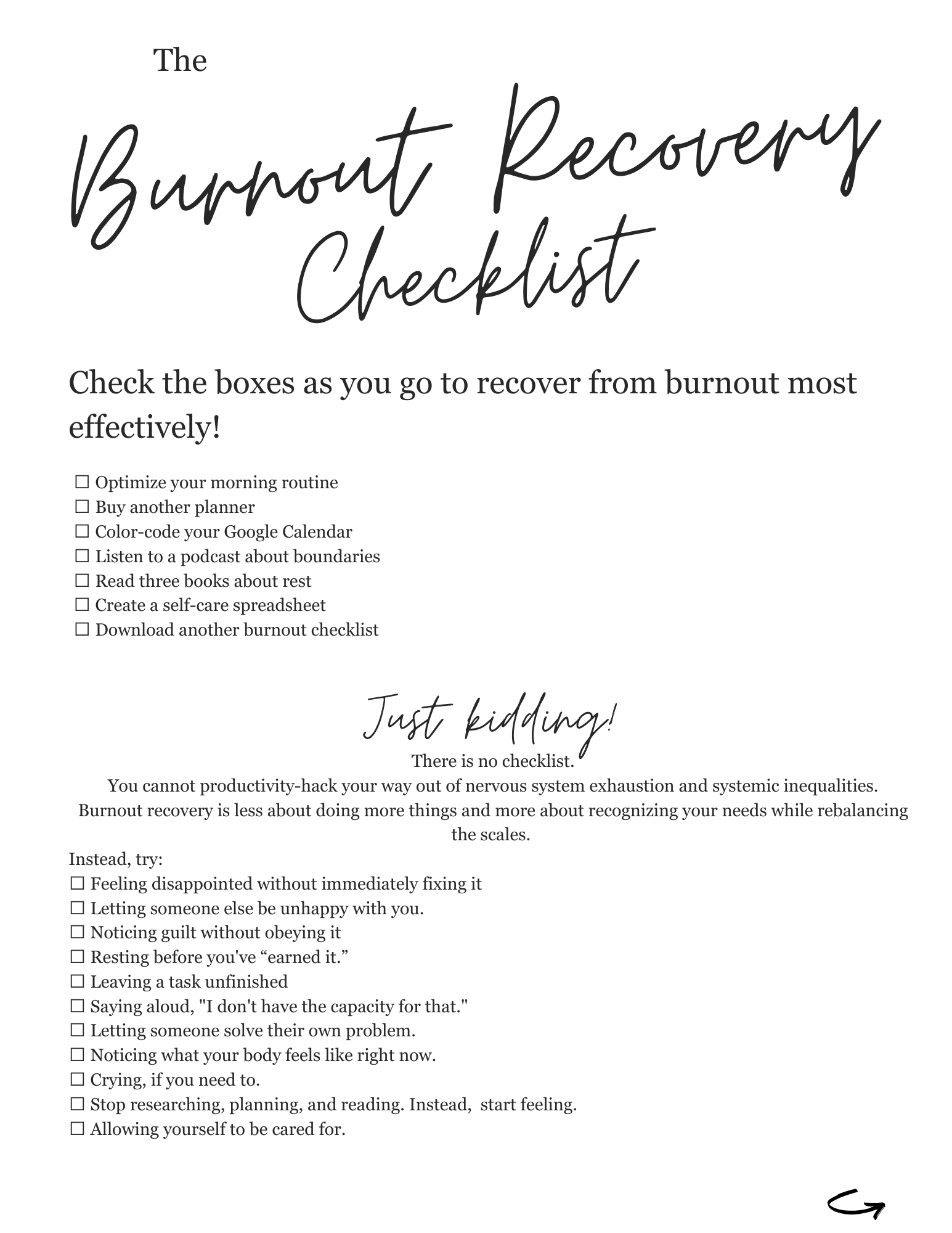
The biggest burnout plot twist?
There is no checklist.
Every time burnout hits, many of us respond the same way:
We search for a better morning routine.
We buy another planner.
We reorganize our Google Calendar.
We color code our task list.
We listen to another podcast about boundaries.
We save another Instagram post about nervous system regulation.
We create an entire recovery plan.
It makes sense. We have spent years believing that if something feels wrong, the answer is to work harder at fixing it. So naturally, when burnout arrives, we try to become really good at recovering.
But, I am here to tell you that will never make you feel better in the long-run or fix the underlying problem. Here’s the truth: There is no checklist.
That sentence can feel disappointing and upsetting. We would prefer a concrete outline that includes a step-by-step plan with checkboxes, action items, and estimated timelines. Without the false sense of structure, we can feel overwhelmed and out of control. However, living life without a checklist can also be incredibly freeing.
Burnout recovery is not another achievement to unlock nor another certification to earn. It is not another perfectly optimized morning routine. We cannot productivity hack our way out of nervous system exhaustion or systemic inequalities.
Recovery begins when we stop asking, "What else should we do?" and start asking, "What created this problem?"
The Trap of Doing More to Feel Better
When Recovery Becomes Another Performance
Burnout has a sneaky way of convincing us that recovery requires more effort. Suddenly, we are researching instead of resting.
Reading instead of recovering.
Planning instead of pausing.
Our burnout checklist starts looking something like this:
Read another book about rest.
Listen to three podcasts about boundaries.
Build the perfect self-care spreadsheet.
Download another habit tracker.
Watch videos about nervous system regulation.
Research burnout recovery until midnight.
None of these things are inherently bad. Truly, I believe that knowledge, insight, and learning matter. But at some point, gathering information becomes another way to avoid experiencing what burnout is trying to tell us. Focusing on the ‘tasky items’ enables our avoidance of difficult realities, difficult emotions, and difficult conversations.
Because sometimes researching feels safer than grieving.
Planning feels safer than disappointing someone by saying no.
Organizing feels safer than admitting we are overwhelmed and the vulnerability of asking for help.
Constantly preparing for recovery can become another form of overfunctioning.
If we are honest, many of us are not looking for another strategy or one more thing on our plate. Instead, we are looking for permission.
Permission to stop.
Permission to disappoint someone.
Permission to leave something unfinished.
Permission to acknowledge that our capacity has changed.
That is much harder than buying another planner.
When we notice ourselves endlessly consuming content about burnout recovery, it can be helpful to pause and ask a different question.
What am I trying not to feel right now?
The answer might be sadness.
Fear.
Anger.
Grief.
Loneliness.
Guilt.
Or perhaps the uncomfortable realization is that the systems around us continue to demand more than any one person can sustainably give. Burnout is not simply about doing too much; it is about carrying too much for too long. And no productivity system can solve that.
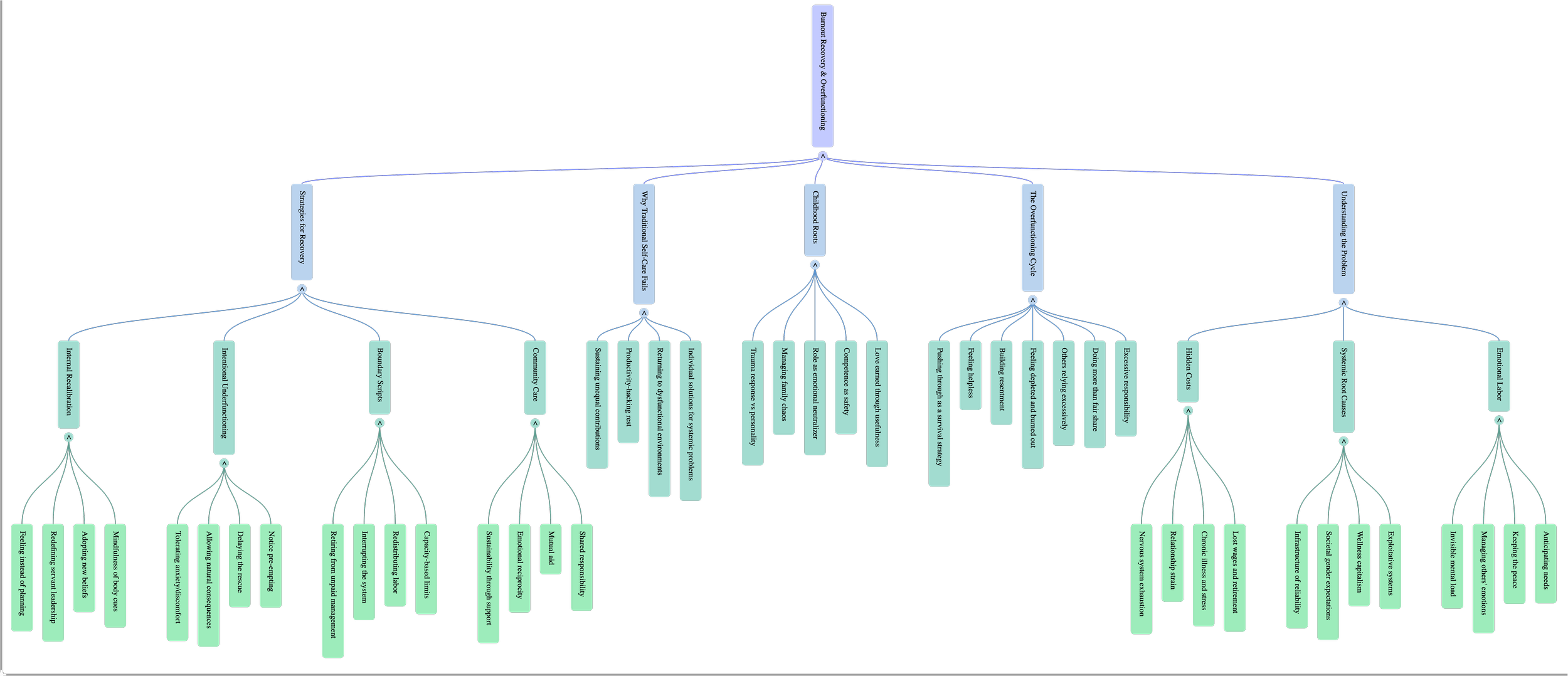
Burnout is a web of people pleasing, emotional labor, nervous system exhaustion, childhood conditioning, workplace expectations, and systems that reward overfunctioning. That is why another planner isn't fixing it.
The Anti Checklist for Burnout Recovery
Recovery Often Looks Less Productive
If burnout recovery is not another checklist, then what does it actually look like?
It often looks surprisingly ordinary.
Less Productive Acts That Are Surprisingly Helpful:
Allowing disappointment to exist without immediately trying to fix it.
Letting someone else experience frustration because we finally set a boundary.
Watching another capable adult solve their own problem instead of automatically stepping in.
Saying, "I don't have the capacity for that."
Not because we are lazy. Because it is true. Many of us have spent years believing our worth comes from being reliable, helpful, accommodating, and endlessly available. That belief fuels people pleasing, overfunctioning, therapist burnout, caregiver burnout, and the quiet exhaustion so many helping professionals carry every day.
Recovery asks us to practice something radically different:
Rest before we have earned it.
Leave an email unanswered until tomorrow.
Allow the laundry to wait.
Accept that our to do list may never be completely finished.
Recognize that feelings of guilt are not instructions.
Naming the Cost of Staying Stuck
There is a cost to continuing life exactly as it is, even if we’ve forgotten about the autopay bill.
10 Costs to Avoiding Burnout Recovery:
Burnout slowly shrinks our world.
We become emotionally unavailable to ourselves.
We stop noticing joy.
We lose our curiosity.
Relationships begin feeling transactional.
Rest feels uncomfortable instead of restorative.
Our nervous system forgets what safety actually feels like.
The longer we stay stuck in overfunctioning, the more normal exhaustion begins to feel.
Eventually we stop asking whether this pace is sustainable.
We simply assume this is adulthood.
Coming Home to Ourselves
Recovery Begins in the Body
Burnout recovery is not just cognitive, it is also deeply physical. Our bodies usually know we have exceeded our capacity long before our minds admit it. Instead of immediately asking what needs to be fixed, we might begin with a much simpler question.
What does my body feel like right now?
Heavy?
Numb?
Buzzing?
Tight?
Restless?
Empty?
There is no wrong answer. Maybe our body asks us to sleep, cry, move, or to simply stop pretending we are okay. Often, our body asks us to receive the care we’ve neglected for so long as part of our recovery. Which can be surprisingly uncomfortable for those of us who have built our identities around caring for everyone else.
How to Practice Receiving Care:
Accept the meal someone offers.
Let someone check on us.
Allow another person to carry part of the emotional load.
We were never meant to do this alone. Connection is one of the ways our nervous system remembers safety. And, our recovery and connection rarely look dramatic from the outside. Instead it usually looks like hundreds of small moments where we stop abandoning ourselves, choosing our needs without apologizing, building boundaries that protect our humanity instead of proving our productivity, recognizing that burnout is not a personal failure but the predictable outcome of systems that reward endless output while ignoring human limits.
There is no checkbox for coming home to ourselves.
There never was.
Today, instead of searching for another burnout checklist, try something different.
If burnout recovery feels impossible alone, therapy can help us untangle the patterns of people pleasing, overfunctioning, and chronic self abandonment while reconnecting with what sustainable living actually feels like.
Schedule a consultation at:https://sageholisticcounseling.clientsecure.me/sign-in
Explore more resources at:www.SageHolisticCounseling.com/shc-blog